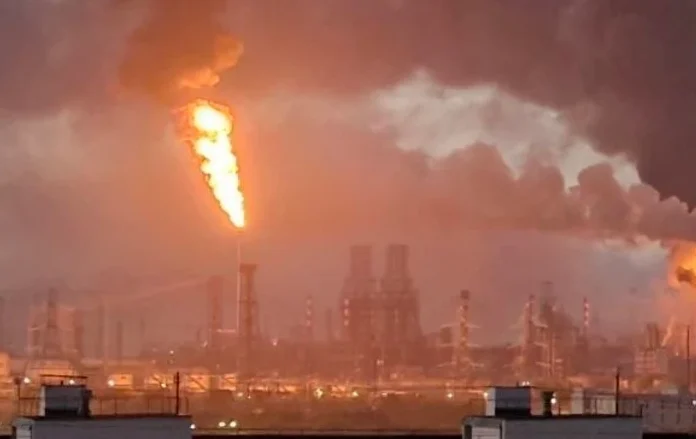
Ukraine has struck the Slavneft YANOS oil refinery in Yaroslavl for the second time in under a month, and this time the damage reached deeper than before. The strike on September 17 damaged the refinery’s AVT-3 primary crude distillation unit, which can process 17,140 metric tons per day and accounts for about 40 percent of the plant’s total processing capacity. A separate unit, AVT-4, responsible for another 33 percent of capacity, was already offline for repairs after an earlier drone strike on August 28. With both units down, the refinery lost roughly three quarters of its processing capability in a single stretch.
This is not an isolated incident. It is a pattern, and Moscow has yet to find an answer for it.
Regional Governor Mikhail Yevrayev confirmed the damage in a post on Telegram, writing simply that there was damage to the oil refinery. He reported no casualties and said the fire was fully extinguished by Thursday morning. The plant, jointly controlled by Rosneft and Gazprom, has a crude processing capacity of 300,000 barrels per day, roughly 15 million metric tons annually, making it one of the largest refineries in the country.
President Volodymyr Zelensky confirmed the operation and framed it in stark military terms. Ukraine’s military has previously stated that the Slavneft YANOS facility supplies fuel and lubricants directly to the Russian armed forces. That distinction matters. This is not a civilian gas station. It is a node in the supply chain that keeps tanks fueled and aircraft flying.
What should alarm Moscow more than the damage itself is the frequency. Industry monitors tracking the plant count at least eight separate fires at the facility in 2026 alone, spread across March, April, May twice, July twice, August and now September. A refinery that has absorbed eight strikes in a single year and kept operating is unusual. But the interval between hits is shrinking, and the damage from each successive strike is compounding rather than healing.
Analysts covering the campaign note that a plant hit repeatedly does not automatically shut down, since the refineries that have gone fully offline took months of sustained strikes to reach that point. Yaroslavl has not shut down yet. But it is bleeding capacity in real time, unit by unit, faster than Russian repair crews can keep pace.
This single refinery is a symptom of a much larger collapse. The International Energy Agency estimates Russia’s overall oil refining capacity has fallen 45 percent since the war began, with 450,000 barrels per day of capacity lost to sustained Ukrainian strikes. That decline has produced fuel shortages now affecting 92 percent of Russian regions, forcing rationing measures and export restrictions on a country that built its entire war economy on energy exports. By mid 2026, Russian oil throughput had dropped to its lowest level in more than two decades, with gasoline output down 20 percent and diesel production down nearly 30 percent compared to 2024. Motorists in some regions have reported waiting up to 40 hours in line for fuel.
None of this is accidental. Ukraine has struck Russian oil facilities more than 300 times since the full scale invasion began in February 2022, and the pace has accelerated sharply each year, from roughly a dozen strikes in the first two years combined to well over a hundred a year by 2026. This is a campaign built on intelligence, patience and repetition, not a series of lucky hits.
What makes the Yaroslavl case so revealing is the timing. Russia had not finished repairing the August damage before the September strike landed on a different but equally critical unit. That sequencing suggests Ukraine is not simply hitting targets of opportunity. It is tracking Russian repair timelines and striking again before recovery is complete, a tactic designed to keep the facility permanently crippled rather than temporarily inconvenienced.
Moscow’s public response has been muted, largely limited to local governors confirming fires and denying casualties. There has been no comprehensive damage assessment from federal energy officials, and no public accounting of how much refining capacity Russia has actually lost nationwide. That silence is its own kind of admission.
The open question now is how far this campaign extends. Ukraine has already shown it can return to the same target twice within weeks. Whether it broadens the list of refineries under sustained pressure or continues concentrating fire on facilities like Yaroslavl to maximize cumulative damage will shape how much of Russia’s fuel infrastructure survives the winter intact.
For now the trend line is clear. Every strike Russia cannot fully repair before the next one lands is capacity that does not come back.