The IMF’s chief economist says strong AI demand pushed trade growth in Asia above the global average, as new forecasts show AI investment holding up the world economy.
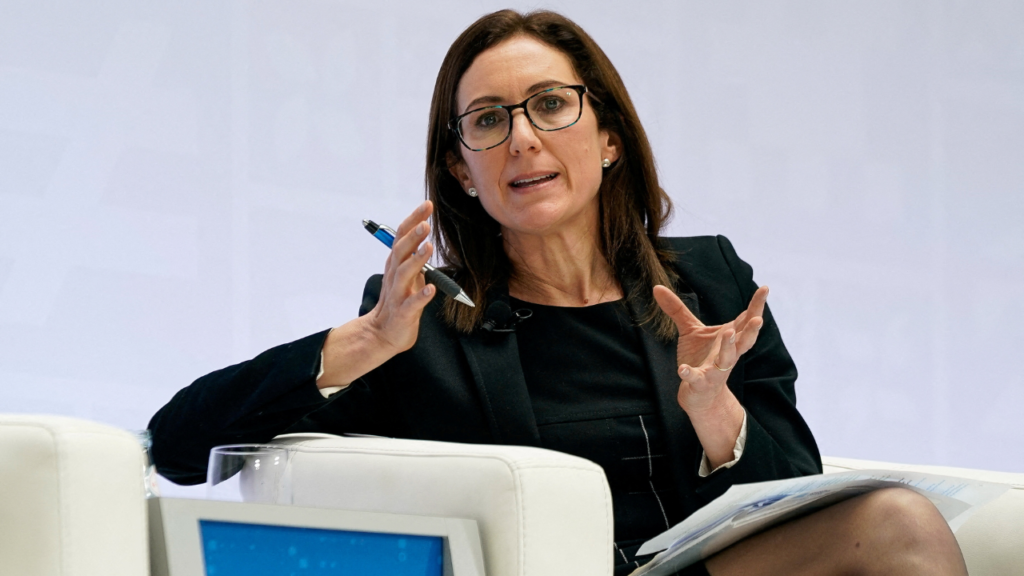
The AI boom in global trade lifted growth in China, India and other Asian economies, IMF chief economist Silvana Tenreyro said on Tuesday, according to Reuters. She told reporters at the IMF and World Bank annual meetings in Bangkok that world trade would have grown far more slowly without the surge in AI demand. The comments came as the fund released its latest World Economic Outlook with a higher global growth forecast.
What Silvana Tenreyro Said at the Bangkok Meetings
Reuters reported that Tenreyro said demand for AI had outpaced overall growth in global trade. She also said the IMF remains worried about high public debt. According to the same report, she urged governments to cut budgets to narrow deficits and asked central banks to raise interest rates to bring inflation back to target.
Trade Figures Behind the AI Boom in Global Trade
Free Malaysia Today reported that global trade grew 8.3 percent between 2023 and 2025, helped by a 29 percent jump in trade linked to AI. Without that jump, the outlet said, growth would have been 4.6 percent. It added that supply chains remain concentrated in a few countries and sectors, which could create bottlenecks.
IMF World Economic Outlook and the Global Growth Forecast
Reuters said the IMF now expects the world economy to grow 3.1 percent in 2026, up from the 3.0 percent it predicted in July but below 3.5 percent in 2025. The fund forecasts 3.4 percent for 2027. Reuters said strong AI investment offset the energy shock from the war in the Middle East, which has kept oil above $100 a barrel. Xinhua reported that the outlook is titled “Resilience Under Strain, Urgent Choices.”
Tenreyro told a news conference that “the global economy has been resilient, but that resilience is reaching its limits,” Reuters reported.
How China and India Are Faring
According to Reuters, India remains the fastest growing major economy, with growth forecast at 7.0 percent in both 2026 and 2027. That is up 0.6 percentage points this year and 0.3 points next year from July. The IMF credited robust domestic demand, services activity and AI investment.
Reuters said China’s growth is forecast at 4.5 percent in 2026 and 4.0 percent in 2027, each down 0.1 points from July. The fund said higher oil prices are worsening weak domestic demand, even as exports stay strong. Reuters also reported upgrades for AI hardware suppliers such as South Korea, Malaysia, Mexico and Thailand.
Which Countries Are Being Left Behind
The IMF noted a widening gap between economies that gain from AI and those that do not. Reuters reported that 32 countries now account for 95 percent of global growth, compared with 54 in April. The fund has cut forecasts for 47 percent of economies since April, including several energy importers outside AI supply chains.
The Citizen reported that IMF Managing Director Kristalina Georgieva said trade growth tied to AI is driven mainly by the United States, China and India. She described AI as “a key driver of countries’ relative fortunes.”
Will the AI Boom in Global Trade Last?
The IMF does not offer a guarantee. Reuters said the report calls AI a major source of uncertainty with both upside and downside risks. Faster adoption could lift global output a further 0.6 percent by 2029. If productivity gains fail to appear and investment drops sharply, US output could fall 0.8 percent directly. Reuters said the combined global hit could reach 1.1 percent by 2028. Free Malaysia Today reported that the IMF baseline assumes the boom fades over time.
Tenreyro also named a longer and more intense Middle East war, rising bond yields and extreme weather linked to El Nino as risks, according to Reuters. The fund projects global consumer price inflation of 4.7 percent in 2026 and 4.1 percent in 2027.
Tamrah News will update this report on the AI boom in global trade as the IMF and World Bank meetings in Bangkok continue.
FAQs
What did the IMF say about the AI boom in global trade?
IMF chief economist Silvana Tenreyro said strong AI demand boosted growth in China, India and other Asian countries and outpaced overall global trade growth, according to Reuters.
How did the AI boom in global trade help China and India?
Strong AI demand and AI investment supported exports and growth. The IMF forecasts India at 7.0 percent and China at 4.5 percent for 2026.
What is the IMF global growth forecast for 2026?
The IMF World Economic Outlook puts 2026 global growth at 3.1 percent, up from 3.0 percent in July, and 3.4 percent for 2027.
Who is Silvana Tenreyro?
She is the IMF’s chief economist and spoke to reporters at the IMF and World Bank Bangkok meetings.
What are the risks to AI investment and global trade growth?
The IMF lists a prolonged Middle East war, rising bond yields, extreme weather and weaker than expected AI profits.