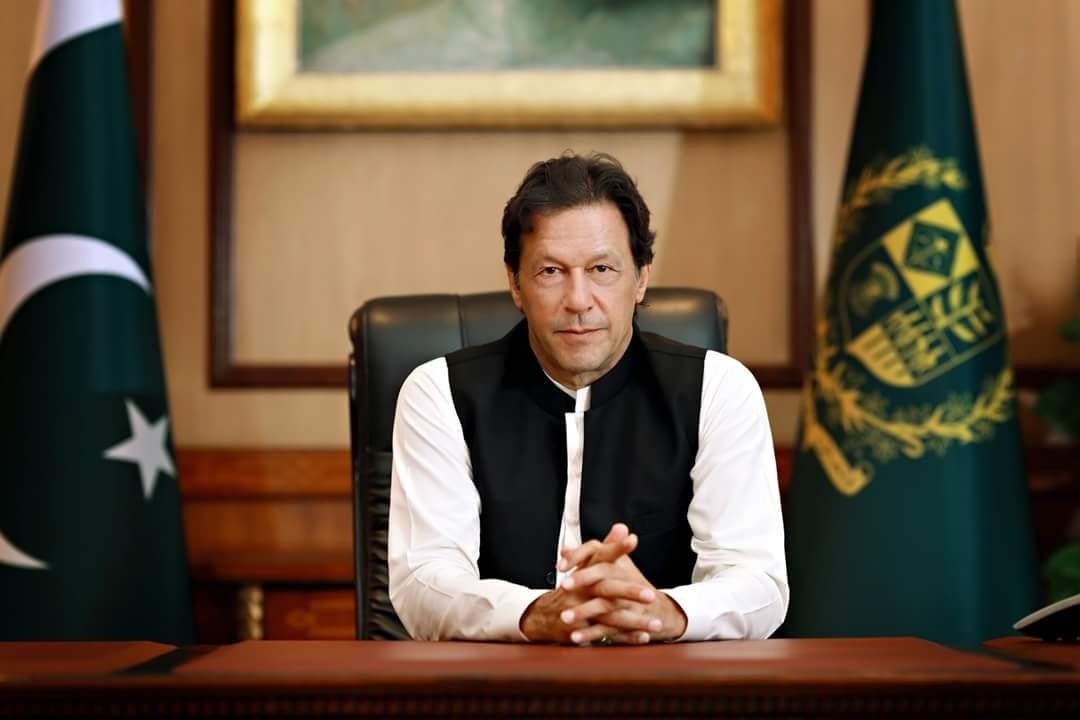
From the removal of an elected government to political imprisonment, disputed elections, deaths in custody and the concentration of military power in Pakistan
Pakistan’s political crisis did not begin with the imprisonment of former prime minister Imran Khan. Nor did it begin with the events of 9 May 2023. Its roots lie in a much longer struggle over who exercises power in Pakistan, who determines the country’s political direction and whether elected representatives can govern without the intervention of the military establishment.
The removal of Imran Khan’s government in April 2022 marked a decisive moment in that struggle. What followed was a succession of political confrontations, arrests, criminal cases, protests, disputed elections, deaths, constitutional amendments and allegations of institutional interference. The imprisonment of a former prime minister and his wife became one of the most visible expressions of a wider crisis involving the judiciary, Parliament, the media and the rights of ordinary citizens.
By November 2026, Imran Khan was still behind bars. His political party continued to face restrictions and its supporters continued to demand his release. His wife, Bushra Bibi, was also imprisoned. His sisters had faced prolonged detention. His medical condition had become a matter of urgent judicial concern. In an open letter to Pakistan’s senior judges, Khan warned that he might not return alive.
Understanding how Pakistan reached this point requires examining the events in chronological order.
1. April 2022: The removal of Imran Khan’s government
Imran Khan became prime minister in August 2018 after the Pakistan Tehreek e Insaf (PTI) emerged as the largest party in the National Assembly following the general election. His government depended on a coalition of political parties and parliamentary allies. During its tenure, Khan’s relationship with the military establishment was initially widely regarded as cooperative. That relationship deteriorated as disagreements emerged over political appointments, governance and the balance of authority between the elected government and the military leadership.
General Qamar Javed Bajwa was serving as Chief of Army Staff. He had received an extension in 2019 under Khan’s government. By 2021, the relationship between the prime minister and the army chief had become increasingly strained. The dispute surrounding the appointment of the Director General of the Inter Services Intelligence was an important public indication of the breakdown.
In March 2022, opposition parties moved a no confidence resolution against Khan. The opposition argued that it had secured sufficient parliamentary support to remove the government. Khan, however, alleged that the campaign against him was supported by external interests and facilitated by powerful actors inside Pakistan.
On 3 April 2022, Deputy Speaker Qasim Suri dismissed the no confidence resolution, citing an alleged foreign conspiracy. Khan advised President Arif Alvi to dissolve the National Assembly.
The Supreme Court intervened. On 7 April 2022, a unanimous five member bench declared the deputy speaker’s ruling unconstitutional and restored the National Assembly. It also set aside the dissolution of Parliament and ordered that the no confidence vote proceed.
On 10 April 2022, Imran Khan was removed from office after the no confidence motion succeeded. Shehbaz Sharif became prime minister.
Khan described his removal as a regime change operation. He alleged that the military establishment under General Bajwa had played a decisive role in the political developments and that foreign pressure had been used to remove his government. He repeatedly referred to a diplomatic cable from Pakistan’s ambassador in Washington as evidence of pressure against his premiership.
The United States rejected the allegation that it had orchestrated his removal. The military establishment also denied responsibility for the political transition.
The Supreme Court’s judgment, however, established an important constitutional fact: the deputy speaker’s attempt to prevent the no confidence vote and dissolve Parliament was unlawful. The vote subsequently took place and the government changed.
The political question surrounding the removal was never limited to the parliamentary arithmetic. It concerned the influence of institutions that are not elected by the public and the extent to which Pakistan’s political leadership can operate independently.
2. The diplomatic cable and the allegations of foreign interference
The diplomatic cable became central to Khan’s explanation of his removal. It concerned a meeting between Pakistan’s then ambassador to the United States, Asad Majeed, and US Assistant Secretary of State Donald Lu in March 2022.
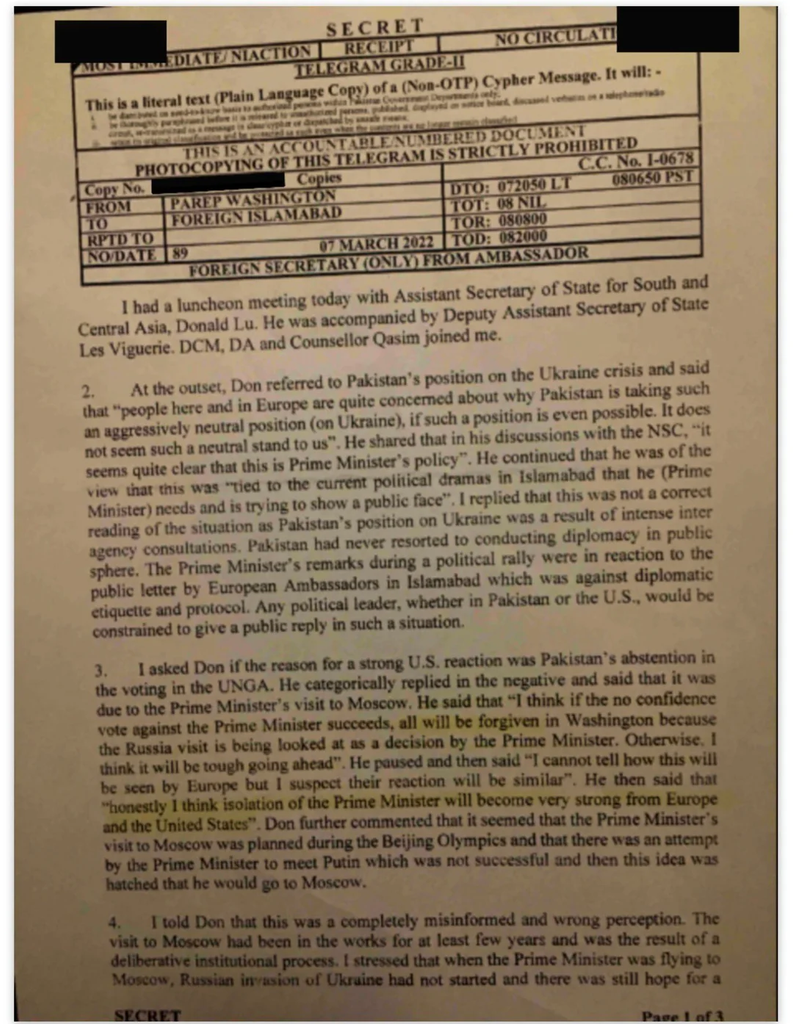
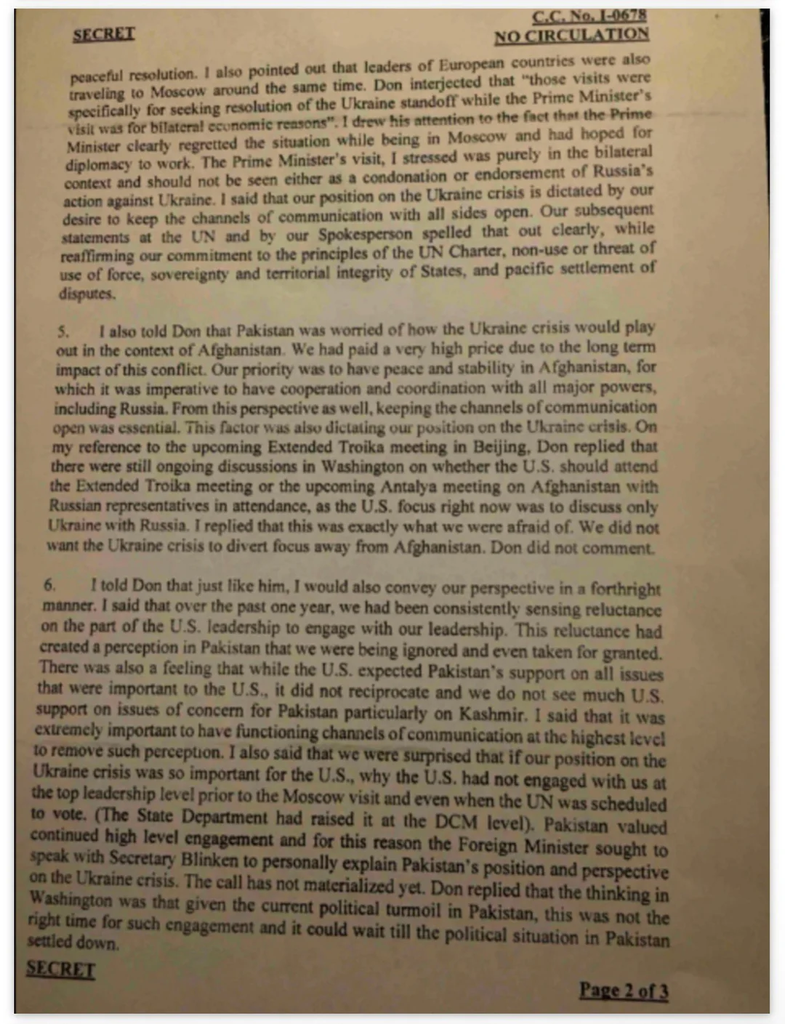
Khan argued that the communication showed that Washington was unhappy with his government’s independent foreign policy and that the political consequences of his removal had been discussed. He described the events as a foreign conspiracy and repeatedly raised the issue in public speeches.
The National Security Committee considered the diplomatic communication and expressed concern about the language used in the meeting. Pakistan issued a diplomatic demarche. The government that replaced Khan subsequently reviewed the matter and did not accept his interpretation as proof of a conspiracy.
The controversy became even more significant when the cipher was discussed during Khan’s prosecution under the Official Secrets Act. Khan and former foreign minister Shah Mahmood Qureshi were convicted in January 2024 and sentenced to ten years. On 3 June 2024, the Islamabad High Court acquitted both men.
The conviction and subsequent acquittal demonstrated how a matter of national security had become inseparable from the political conflict surrounding the former government.
The question of foreign interference should not be reduced to a slogan. Pakistan’s diplomatic communications, the National Security Committee proceedings and the testimony of officials involved deserve transparent examination. Equally, allegations of conspiracy should not be treated as established fact without evidence.
3. General Bajwa’s departure and General Asim Munir’s appointment
General Qamar Javed Bajwa completed his tenure in November 2022. Prime Minister Shehbaz Sharif appointed General Asim Munir as his successor. Munir assumed command of the Pakistan Army on 29 November 2022.
Munir had previously served as Director General of the ISI. His tenure in that position ended in 2019 after a reported disagreement with Imran Khan’s government.
The change of army chief did not resolve the political conflict. Khan continued to accuse the military establishment of interfering in civilian affairs. The relationship between PTI and the military leadership deteriorated further as the party organised demonstrations and challenged the legitimacy of the government.
The appointment of an army chief is constitutionally made through the civilian government. However, the history of Pakistan demonstrates that the office carries influence extending far beyond military command. The military establishment has repeatedly shaped national political decisions, foreign policy and the direction of successive governments.
The transition from Bajwa to Munir therefore took place against a background of allegations that the military establishment had already played a central role in the removal of Khan’s government.
The question of institutional accountability would become increasingly important as General Munir’s authority expanded and the confrontation with PTI intensified.
4. 2022 and 2023: Political mobilisation, arrests and the Wazirabad shooting
Following his removal, Imran Khan launched a nationwide political campaign demanding early elections. PTI organised rallies, long marches and public demonstrations. Khan argued that the new government lacked a genuine public mandate and that the country needed fresh elections.
The campaign brought him into direct confrontation with the federal government and the military establishment.
On 3 November 2022, during a long march in Wazirabad, Khan was shot and injured. Several other people were also injured and one PTI supporter was killed. Khan accused senior figures within the security establishment and government of involvement in an alleged assassination attempt. The individuals he named denied the allegations.
The shooting intensified the political crisis. Khan demanded an investigation and accountability. His supporters viewed the attack as an attempt to eliminate a political leader who had become a serious challenge to the established political order.
The investigation and prosecution surrounding the attack did not produce a publicly accepted final account capable of resolving all the questions raised by Khan and his supporters.
The attack also established an important context for the later events of 9 May 2023. By that time, the country was already experiencing an extraordinary level of political hostility, with Khan’s supporters accusing the state of attempting to silence their leader and the government accusing PTI of creating instability.
5. Ali Bilal, known as Zille Shah: A death before the May 9 crackdown
On 8 March 2023, PTI worker Ali Bilal, widely known as Zille Shah, died in Lahore after being taken to hospital with serious injuries.
His death became a major political controversy. PTI alleged that he had been subjected to violence while in state custody. Police presented a different account and investigated individuals accused of causing his death.
The case demonstrated the danger of political confrontation in which the treatment of detained activists becomes a matter of public dispute. A death involving a political worker requires an independent investigation, reliable medical evidence and transparent disclosure of the circumstances.
The investigation must establish the chain of events leading to the death, the identity of everyone who had contact with the victim and whether any state personnel were involved.
Zille Shah’s death occurred before the 9 May events. It should not be confused with the later deaths during the May crackdown or the November 2024 protests. It is nevertheless an important part of the chronology of violence and allegations of abuse surrounding PTI’s confrontation with the state.
6. 9 May 2023: Imran Khan’s arrest and the attacks on military installations
On 9 May 2023, Imran Khan was arrested by paramilitary Rangers from the premises of the Islamabad High Court. The arrest was connected to the Al Qadir Trust case.
The manner of the arrest immediately raised legal questions. Rangers personnel entered the court premises and took Khan into custody. His lawyers argued that the arrest violated the law and the sanctity of the court.
On 11 May, the Supreme Court declared the arrest unlawful and directed that Khan be produced before it. The court’s intervention did not end the political crisis. It intensified the confrontation between PTI supporters and the state.
Protests erupted in several cities. Military installations, public buildings and other properties were attacked. In Lahore, demonstrators entered the residence of the corps commander, commonly known as Jinnah House. Other military and government sites were also targeted.
The destruction was serious and demanded investigation. Attacks on public property and military installations cannot be justified as peaceful protest. Those responsible for violence must be identified and prosecuted through lawful procedures.
However, the events of 9 May also became the foundation for one of the largest political crackdowns in Pakistan’s recent history.
The government and military leadership presented the attacks as evidence of an organised assault on the state. PTI rejected the collective attribution of responsibility and argued that the violence was subsequently used to justify the elimination of its political leadership and the suppression of its supporters.
The central question was not whether violence occurred. It did. The questions were who organised it, who participated, whether anyone deliberately provoked it and whether the authorities investigated every relevant piece of evidence.
7. The unanswered questions surrounding the 9 May footage
The public debate over 9 May cannot be settled through selected video clips or official statements alone.
Thousands of videos and recordings circulated through social media and other platforms. Some were presented as evidence of attacks by PTI supporters. Others raised questions about the conduct of people in uniform and unidentified individuals in plain clothes.
Among the material discussed publicly were recordings said to show people in uniform around incidents of arson and masked individuals emerging from military vehicles carrying sticks. Other recordings were described as showing people provoking demonstrators and escalating confrontations.
These claims require forensic examination of the original recordings. Their authenticity, locations, timestamps and chain of custody must be established. The identities of the people visible in them must be investigated rather than assumed.
The Punjab Forensic Science Agency reportedly examined approximately 18 gigabytes of CCTV footage collected from Punjab Safe City cameras and military and civilian installations. A report published in June 2023 described the sequence of events and identified PTI leaders and other suspects in the movement towards Jinnah House.
The authorities have therefore acknowledged that substantial video evidence exists. Yet the public has not been provided with a complete and independently examinable record of all the relevant footage.
Military cantonments and sensitive installations are controlled environments. Security cameras, access records and operational records are not ordinarily available to the general public. This makes the release and independent examination of relevant footage particularly important.
The investigation must answer several questions.
Which cameras were operating on 9 May? Which recordings were preserved? Were there missing periods? Were the original files retained? Were recordings from military installations examined alongside civilian recordings? Were the identities of people in uniform and plain clothes established? Were investigators able to trace the movements of individuals through geofencing and other forensic methods? Were all relevant findings presented to courts?
The public also needs to know whether evidence that may contradict the official account was examined with the same seriousness as evidence supporting the prosecution.
The state cannot demand that the public accept an incomplete record while withholding the material needed to evaluate its claims. If the footage establishes the guilt of PTI leaders, it should be presented in court. If footage raises questions about the conduct of state personnel or unidentified provocateurs, those questions must also be investigated.
The demand is not to excuse violence. It is to establish the truth about every person involved.
8. The crackdown after 9 May: Arrests, disappearances and military trials
Following the violence, security agencies and police launched a nationwide crackdown against PTI leaders, workers and supporters.
Thousands of people were arrested or detained. Homes were raided. Party offices were sealed or searched. Senior political figures were taken into custody. Many PTI leaders publicly announced their departure from the party following arrests and pressure.
The government reported more than 8,000 arrests and hundreds of cases connected to the May 9 violence. Official figures also recorded deaths and injuries during the events. These figures must be distinguished from later deaths during detention and from allegations of enforced disappearance.
The treatment of detained civilians became a major human rights concern.
The government announced that some civilians accused of attacking military installations would be tried under the Pakistan Army Act. This raised a fundamental question about whether civilians should face military trials rather than ordinary criminal courts.
In October 2023, the Supreme Court declared provisions allowing the military trial of civilians in the May 9 cases unconstitutional. The judgment emphasised the constitutional rights to a fair trial and due process.
The legal position changed in May 2025 when a five member constitutional bench of the Supreme Court, by a majority of five to two, restored the relevant provisions of the Army Act and permitted civilian military trials in the cases arising from 9 May.
The reversal raised serious concerns among human rights lawyers and civil liberties organisations. A civilian accused of a criminal offence must be able to challenge the evidence in an independent court with full procedural protections. Military courts operate within the military justice system and do not provide the same institutional independence as ordinary civilian courts.
The question is particularly serious when the accused are political opponents of the state authorities involved in the confrontation.
A government cannot establish the rule of law by weakening the right to a fair trial.
9. How many people have died in Pakistan’s prisons?
The question of deaths in prison must be addressed separately from the deaths of protesters and political activists outside prison.
Pakistan does not publish one complete and consistently updated national register that identifies every death in custody, the prison where it occurred, the cause of death, the status of the investigation and whether the deceased had been detained for political reasons.
Available official records nevertheless reveal a serious picture.
The National Commission for Human Rights, the National Academy of Prison Administration and Justice Project Pakistan reported that Pakistan’s prison population reached approximately 102,026 in 2024. Around 74,918 prisoners were awaiting trial. The prison system was operating at approximately 152 per cent of its authorised capacity.
That means nearly three quarters of the prison population had not been convicted and were awaiting or undergoing trial.
The report documented overcrowding, unhygienic conditions, inadequate access to clean water, insufficient healthcare and limited contact with families and legal counsel.
The official information supplied by Pakistan to the United Nations Committee against Torture also recorded deaths in custody in provincial prisons.
For Punjab, the government stated that 257 prisoner deaths were recorded in 2024. The accompanying table listed 257 deaths classified as natural causes, three suicides, six cases classified as alleged abuse and 41 deaths classified as illness. These category figures total 307, creating an inconsistency within the same official submission that requires clarification.
The same table recorded 240 deaths classified as natural causes, five suicides and 23 deaths from illness in Punjab in 2023, a total of 268.
For Khyber Pakhtunkhwa, the government reported 52 male and one female prisoner deaths in 2024. In 2023, it reported 54 male prisoner deaths.
These figures are prison deaths, not a verified count of political prisoners killed by the state. They must not be presented as proof that every death resulted from torture or deliberate killing. Equally, the official classification of a death as natural or illness related does not remove the need for transparent medical records and independent investigation where abuse is alleged.
The discrepancy in the Punjab figures is itself a reason for the government to publish a complete and reconciled record.
The wider prison system is under severe strain. More than 100,000 people were held in a system designed for substantially fewer prisoners. Thousands of detainees were awaiting trial. Overcrowding and inadequate healthcare create conditions in which preventable illness, medical neglect and violence can become fatal.
For political detainees, the issue is particularly urgent. A prisoner must not be denied medical care, family contact or legal access because of political affiliation.
Pakistan needs a national register of deaths in custody. It should identify the prison, date, cause of death, medical findings, postmortem report, inquiry officer and outcome of any investigation. Families must receive the records and have access to independent legal proceedings.
Without such a register, the country cannot establish how many people have died in custody, how many deaths were preventable and whether anyone has been held accountable.
10. The human cost of political detention
The death of a prisoner is not the only measure of custodial abuse. Enforced disappearance, torture allegations, denial of medical treatment, prolonged detention without trial and restrictions on access to lawyers can also constitute grave violations of fundamental rights.
The cases surrounding PTI supporters have included allegations of mistreatment during arrest and detention. Families have reported difficulties locating detained relatives and obtaining information about their cases. Lawyers have raised concerns about access to detainees and the use of anti terrorism laws in political prosecutions.
One case that attracted national attention was that of Ali Bilal, known as Zille Shah. Other cases involving deaths in custody or disputed circumstances have also been raised by political parties and families. Each case must be examined individually. A death in custody should never be dismissed without a credible medical and legal investigation.
The public also needs a distinction between people killed during demonstrations, people who died after being arrested, people who died in prison from illness and people whose whereabouts remain unknown. Combining these categories into one number would obscure the evidence and make accountability more difficult.
The absence of a complete national record is not a reason to ignore the allegations. It is a reason to demand a proper investigation.
11. The May 2023 Toshakhana conviction and the August arrest
On 5 August 2023, Imran Khan was arrested from his residence in Lahore after a trial court convicted him in the Toshakhana case. The court sentenced him to three years in prison and imposed a fine.
The case concerned the declaration and sale of gifts received by Khan while he was prime minister. The Election Commission had filed a criminal complaint alleging that he had concealed details of assets connected to gifts from the state gift repository.
The trial and arrest attracted criticism because the verdict was delivered while Khan was absent and his lawyers were not present in court. His legal team challenged the conviction.
In August 2023, the Islamabad High Court suspended the three year sentence. However, Khan remained in custody because of other cases.
The August arrest marked the beginning of his continuous imprisonment. He was transferred between detention facilities and eventually held at Adiala Jail in Rawalpindi.
The legal cases multiplied. Khan faced allegations connected to state gifts, the diplomatic cable, the Al Qadir Trust, the 9 May violence and other matters. PTI argued that the accumulation of cases was designed to keep him out of politics. The government maintained that the cases were based on evidence and that Khan was required to face the law like any other citizen.
The central issue was whether the proceedings were conducted through fair trials, independent courts and consistent application of the law.
12. The cipher conviction and acquittal
On 30 January 2024, a special court convicted Imran Khan and former foreign minister Shah Mahmood Qureshi in the cipher case. Both were sentenced to ten years in prison under the Official Secrets Act.
The case concerned Khan’s handling and public discussion of a classified diplomatic communication. Khan argued that the communication was evidence of foreign pressure against his government and that the prosecution was politically motivated.
On 3 June 2024, the Islamabad High Court acquitted both Khan and Qureshi.
The acquittal was a major development in the legal battle. It demonstrated that a conviction in a politically consequential case could be overturned through the ordinary appellate process. It also raised questions about the original trial and the evidence relied upon to convict the two political leaders.
13. The January and February 2024 convictions
On 31 January 2024, Khan and Bushra Bibi were sentenced to fourteen years in prison in another Toshakhana case. The prosecution alleged that state gifts had been undervalued and retained improperly.
On 3 February 2024, a court sentenced Khan and Bushra Bibi to seven years in prison in a case concerning the Islamic waiting period before their marriage.
Both convictions became part of a wider series of proceedings that took place immediately before the general election.
In July 2024, the Islamabad High Court acquitted Khan and Bushra Bibi in the marriage case.
The sequence of convictions and acquittals became central to the argument that the legal system was being used to restrict Khan’s political participation. The government rejected the allegation and maintained that the courts were dealing with separate criminal matters.
The responsibility of the judiciary is to ensure that every case is decided on its evidence and legal merits. A conviction should not be used as a political instrument. Nor should a defendant be exempt from prosecution because of political popularity.
14. February 2024: The election and the Form 45 and Form 47 controversy
Pakistan held its general election on 8 February 2024.
PTI was unable to contest under its traditional electoral symbol after the Supreme Court upheld the Election Commission’s decision concerning the party’s intra party elections. Its candidates were therefore required to contest as independents.
The campaign took place amid arrests, restrictions on political activity and allegations of unequal treatment. PTI leaders and supporters argued that the party had been deliberately weakened before polling day.
On election day, mobile phone and cellular services were suspended across the country. The government cited security concerns. The shutdown disrupted communications and created difficulties in transmitting results.
The controversy intensified when preliminary polling station results appeared to differ from the consolidated results announced by returning officers.
Form 45 is the polling station result form. It records the votes counted at an individual polling station. Form 47 is the consolidated result prepared by the returning officer.
PTI candidates and election observers alleged that in several constituencies the Form 47 results did not match the figures recorded in Form 45.
The PATTAN and Coalition 38 election audit examined Islamabad’s three National Assembly constituencies. The organisations collected polling station forms and compared their totals with the consolidated results published by the Election Commission. Their audit reported substantial differences and claimed that candidates declared winners had received fewer votes than their opponents according to the available Form 45 records.
In NA 47, the dispute involved PTI backed candidate Shoaib Shaheen and PML N candidate Tariq Fazal Chaudhry. PATTAN’s audit argued that the polling station records indicated a different result from the one officially declared.
The Commonwealth Observer Group’s final report also identified serious weaknesses in the electoral environment. It found that the cellular shutdown disrupted the Election Management System, forced manual transmission of results and reduced transparency. It also said the shutdown created opportunities for manipulation of Forms 45, 46 and 47.
The report recorded that institutional decisions had consistently limited the ability of one particular political party to contest the election. It concluded that these decisions affected the credibility, transparency and inclusiveness of the electoral process.
The Commonwealth observers did not establish that every discrepancy was deliberate manipulation. However, their findings confirmed that the electoral process suffered from serious problems.
The Election Commission and the courts should have resolved the disputes through a constituency by constituency examination of original polling station records. The public should not have been expected to accept disputed results without transparent verification.
The election produced a government led by Shehbaz Sharif. PTI and its supporters continued to challenge the legitimacy of the results and demanded an investigation.
The central democratic question remains: when polling station records and consolidated results conflict, which record determines the public mandate?
15. The 24 to 27 November 2024 protest and the deaths in Islamabad
On 13 November 2024, PTI announced a protest in Islamabad for 24 November. The demands included the release of Imran Khan and other detained political leaders and an investigation into the alleged manipulation of the February election.
The protest took place amid an already tense political environment. The federal government opposed the march and deployed security forces. Roads were blocked and communications were disrupted.
By 26 November, thousands of PTI supporters had gathered in Islamabad. The government launched a clearance operation. Security forces used tear gas and other methods to disperse protesters. Reports emerged of live ammunition and deaths.
The government denied that civilians had been killed by security forces. PTI leaders alleged that protesters had been shot and killed. The party initially made claims of a much higher death toll. The exact number remained disputed.
The Human Rights Commission of Pakistan conducted a fact finding mission and interviewed state representatives, PTI leaders, journalists and families of seven people allegedly killed during the protest.
Its report concluded that there had been loss of life among protesters, contrary to the federal government’s claims. It also recorded reported deaths among security personnel.
The commission raised serious concerns about allegations that police and hospital administrations withheld bodies until families agreed not to pursue legal action. It also criticised the excessive and disproportionate use of force and the lack of transparency surrounding the operation.
The report highlighted the media blackout and the difficulty of obtaining reliable information during the crackdown. Internet restrictions and the absence of independent reporting made it harder for the public to establish what had happened.
The United Kingdom government’s country information report later summarised the conflicting accounts. It recorded that PTI leaders had made claims of multiple deaths and that the HRCP had interviewed families of seven alleged victims. The government maintained that no protesters had been killed by security forces.
The issue requires an independent investigation. Every reported death must be verified through hospital records, postmortem examinations, family testimony and available video footage. Families must be allowed to pursue legal action without intimidation.
The state has a responsibility to protect public order. It also has a responsibility not to use disproportionate force against demonstrators. The right to peaceful protest is protected by the Constitution. It cannot be suspended simply because a demonstration challenges the government.
The question is not whether protesters and security personnel both faced danger. The question is whether the state used lawful and proportionate force and whether the deaths were independently investigated.
16. The imprisonment of Bushra Bibi
Bushra Bibi became one of the most prominent targets of the legal proceedings against Imran Khan.
She was arrested on 17 January 2025 following her conviction in the Al Qadir Trust case. She received a seven year prison sentence. The case concerned allegations that the couple benefited from land and other arrangements connected to the return of approximately £190 million to Pakistan.
Bushra Bibi denied wrongdoing. Her lawyers challenged the conviction and argued that the proceedings were politically motivated.
Her imprisonment meant that both Khan and his wife were held in custody while their appeals remained pending.
The treatment of Bushra Bibi became a separate human rights concern. Her legal team raised questions about prison conditions, access to medical care and the restrictions placed on her contact with family members.
In 2026, she experienced serious eye problems. Khan later alleged that she had suffered a retinal detachment in April 2026 and undergone complicated eye surgery before being returned to prison.
Her lawyers subsequently sought access to her complete medical records and treatment by doctors of her choice.
The state must ensure that every prisoner receives appropriate medical care. A person’s political position, marriage or family relationship cannot justify inadequate treatment.
17. The 26th Constitutional Amendment and judicial independence
On 21 October 2024, Pakistan’s Parliament passed the 26th Constitutional Amendment.
The amendment changed the process for appointing the chief justice of Pakistan. Instead of automatically appointing the most senior Supreme Court judge, a parliamentary committee would select the chief justice from among the three most senior judges.
It also changed the composition of the Judicial Commission responsible for judicial appointments and introduced constitutional benches.
The International Commission of Jurists criticised the amendment, warning that it increased political influence over judicial appointments and weakened the judiciary’s ability to act as an independent check on the executive and other institutions.
The timing of the amendment was politically significant. It was passed during a period of intense confrontation between the government and PTI and amid concerns about the independence of the courts.
A judiciary must be able to review government decisions, protect fundamental rights and examine allegations of unlawful state action. Its independence is essential when the government itself is involved in a dispute with political opponents.
The amendment therefore raised a fundamental question: can the judiciary independently hold powerful political and military institutions accountable if its appointment structure is increasingly influenced by the political branches of government?
18. The January 2025 Al Qadir Trust conviction
On 17 January 2025, an accountability court convicted Imran Khan and Bushra Bibi in the £190 million Al Qadir Trust case.
Khan received a fourteen year prison sentence and Bushra Bibi received seven years. The court also imposed fines.
The case concerned the return to Pakistan of approximately £190 million identified by the United Kingdom’s National Crime Agency during an investigation involving property developer Malik Riaz.
The prosecution alleged that the money was returned to Pakistan through a settlement arrangement that benefited the property developer and that Khan and his wife received land and other benefits through the Al Qadir Trust.
Khan and Bushra Bibi denied wrongdoing. Their defence argued that the case was politically motivated and that the trust was established for educational purposes.
The verdict was delivered in a temporary courtroom at Adiala Jail. The couple appealed against the convictions.
The case has remained central to Khan’s imprisonment. The Islamabad High Court has heard appeals and applications seeking suspension of the sentences. The appeals remained unresolved in November 2026.
The proper legal question is whether the prosecution proved every element of the alleged offence and whether the trial complied with due process. The court must examine the financial records, the settlement documents, the role of the National Crime Agency and the alleged benefits received by the accused.
A conviction in a major corruption case must withstand independent judicial scrutiny. The same standard must apply to every public official, regardless of political affiliation.
19. December 2025: Another 17 year sentence in Toshakhana II
On 20 December 2025, a special court sentenced Imran Khan and Bushra Bibi to seventeen years in prison each in the Toshakhana II case.
The case concerned a Bulgari jewellery set gifted to Khan by the Saudi crown prince during an official visit in May 2021. The prosecution argued that the jewellery was retained after being undervalued and purchased at a price far below its assessed market value.
Khan and Bushra Bibi denied the allegations and challenged the proceedings.
The court imposed prison sentences under the Pakistan Penal Code and the Prevention of Corruption Act. The couple were also fined.
The defence challenged the verdict in the Islamabad High Court. In February 2026, their lawyers sought suspension of the sentences and release pending the final outcome of their appeals.
The Toshakhana II conviction added another lengthy sentence to Khan’s existing imprisonment. It also meant that his wife faced a second major prison sentence.
The legal system must determine these cases through evidence and fair appellate proceedings. The public must be able to distinguish between a conviction, a suspended sentence, an acquittal and a pending appeal. A person cannot be treated as having exhausted every legal remedy while appeals remain unresolved.
20. The 27th Constitutional Amendment and the expanded authority of the military leadership
On 13 November 2025, Pakistan’s Parliament passed the 27th Constitutional Amendment. It received presidential assent and became law.
The amendment made major changes to the constitutional command structure of the armed forces and the judicial system.
Under the amended Article 243, the Chief of Army Staff also serves as Chief of Defence Forces. The office of Chairman Joint Chiefs of Staff Committee was abolished.
The amendment also created special constitutional arrangements for senior military ranks. A Field Marshal, Marshal of the Air Force or Admiral of the Fleet retains the rank and privileges for life and may remain in uniform for life.
Most controversially, Article 243 was amended to extend protections under Article 248 to the Field Marshal and other specified five star military ranks.
Article 248 provides extensive constitutional protections relating to criminal proceedings and arrest. The extension of those protections to the highest military ranks raised serious concerns about accountability.
The amendment must be examined alongside Article 6 of the Constitution. Article 6 defines high treason to include abrogating, subverting or suspending the Constitution through unconstitutional means. It also applies to those who aid or abet such conduct.
The 27th Amendment did not remove Article 6. However, the extension of Article 248 protections to the Field Marshal creates a significant constitutional question about the relationship between immunity and accountability.
Can a senior military officer be investigated and prosecuted for unconstitutional intervention if constitutional protections prevent criminal proceedings? What happens when allegations concern actions that Article 6 expressly identifies as high treason? How would the courts reconcile the two provisions?
These are questions that require legal examination and public scrutiny.
The amendment also changed the judicial structure by creating the Federal Constitutional Court and transferring constitutional jurisdiction into a new institutional framework.
The speed and political circumstances surrounding the amendment raised concerns among critics about the concentration of authority and the weakening of institutional checks.
The military leadership has described its role in national affairs through the framework of security and stability. But constitutional authority must remain subject to democratic oversight. No individual or institution should become immune from meaningful accountability.
21. Article 6 and the question of equal accountability
Article 6 is one of the most important constitutional safeguards against the unconstitutional seizure or suspension of state authority.
It states that a person who abrogates, subverts or suspends the Constitution by force or other unconstitutional means commits high treason. It also covers those who aid or abet such acts.
The law must apply equally to civilian and military leaders.
In 2024, the federal government announced proceedings under Article 6 against former prime minister Imran Khan, former president Arif Alvi and former deputy speaker Qasim Suri over the April 2022 dissolution of the National Assembly and the rejection of the no confidence motion.
The Supreme Court had already declared the deputy speaker’s ruling unconstitutional and restored the National Assembly.
The announcement of proceedings against civilian political figures raised questions about the consistent application of Article 6. If unconstitutional interference with the Constitution is a crime, the law must not be used selectively against political opponents while shielding other powerful actors from investigation.
Pakistan’s constitutional history includes military coups and periods of direct military rule. The question of accountability for those who suspend or subvert the Constitution cannot be limited to civilian politicians.
The 27th Amendment has made the question more urgent because it extends constitutional protections to the highest military ranks while Article 6 remains part of the Constitution.
A constitutional democracy cannot function on the principle that one class of public officials is subject to prosecution while another class enjoys permanent protection from scrutiny.
22. The military’s role in economic policy and the country’s mineral resources
The role of the military establishment has increasingly extended into economic diplomacy and discussions concerning Pakistan’s natural resources.
Pakistan possesses deposits of copper, gold, antimony, lithium and other minerals that have attracted international interest. The government has sought foreign investment in mining and critical minerals as part of its broader economic strategy.
During a meeting with United States President Donald Trump, Field Marshal Asim Munir presented a wooden box containing samples of rare earth minerals. The gesture was widely reported and became part of the discussion surrounding Pakistan’s mineral diplomacy.
The involvement of the military leadership in discussions concerning critical minerals raises questions about the relationship between national security, economic policy and civilian accountability.
The Frontier Works Organization has also been associated with mineral development and commercial arrangements. The organisation’s involvement in agreements concerning mineral extraction and processing has attracted scrutiny.
Pakistan’s natural resources are not the property of a single institution. Mineral rights, provincial revenues, environmental protections and local community interests must be governed transparently.
The people of Balochistan and Khyber Pakhtunkhwa have a direct interest in how their resources are developed. They must receive a fair share of the economic benefits and must not be excluded from decisions concerning their land.
The public needs access to the agreements, ownership structures, licensing arrangements and revenue distribution mechanisms. It must be clear which institutions negotiate the contracts and which bodies supervise their implementation.
The presentation of minerals to a foreign president is a diplomatic event. The more important question is whether Pakistan’s natural resources are being managed through transparent civilian institutions or whether decisions are increasingly concentrated in unelected power centres.
23. Balochistan: Enforced disappearances and the demand for justice
Balochistan has experienced a prolonged human rights crisis involving enforced disappearances, militant violence, military operations and allegations of extrajudicial killings.
Families of missing people have repeatedly organised protests demanding information about relatives who disappeared after alleged detention by security forces or intelligence agencies.
The issue has affected students, activists, journalists, lawyers and ordinary residents. Families have described years of uncertainty and the absence of information about whether their relatives are alive or dead.
The Human Rights Commission of Pakistan has repeatedly raised concerns about enforced disappearances and the erosion of civic space in Balochistan. It has documented allegations of abductions without warrants and cases in which missing people were later found dead.
A report published by the Human Rights Council of Balochistan on the situation in 2025 documented 1,482 alleged enforced disappearances and 598 killings. The organisation attributed a substantial number of these cases to security forces and state linked groups.
These are the organisation’s documented figures and allegations. They require independent investigation and case by case verification. They cannot simply be dismissed because they concern state institutions.
The state must also confront militant violence. Attacks on civilians, security personnel and public infrastructure must be investigated and prosecuted. But counterterrorism operations cannot be used to justify unlawful detention, torture or extrajudicial killing.
A family has the right to know where a missing person is being held. A detainee must be presented before a court. A person accused of a crime must receive a fair trial.
The people of Balochistan cannot be expected to trust the state when families have spent years demanding basic information about missing relatives.
24. Khyber Pakhtunkhwa: Military operations, drone strikes and civilian casualties
Khyber Pakhtunkhwa has faced a deteriorating security situation involving militant attacks, counterterrorism operations and violence affecting civilian communities.
The province has experienced bombings, attacks on police and security personnel, displacement and military operations. Residents in affected districts have repeatedly raised concerns about the safety of their families and the destruction of homes and livelihoods.
Drone strikes have also raised serious questions about civilian protection.
In June 2025, Amnesty International reported that recurrent drone strikes in Khyber Pakhtunkhwa had killed at least seventeen people, including five children, during that year. The organisation documented reports of strikes affecting homes and a volleyball gathering. It called for independent investigations into civilian deaths.
The use of force must comply with international humanitarian and human rights obligations. The state must distinguish between armed militants and civilians. It must investigate every reported civilian death and provide families with an explanation and access to justice.
The presence of militant groups does not remove the rights of the population. Children, families and ordinary residents must not become invisible casualties of security policy.
The government must publish information about military operations, civilian casualties, investigations and compensation. Without transparency, affected communities cannot know whether the state is protecting them or placing them at further risk.
25. October 2026: Governor’s Rule in Khyber Pakhtunkhwa
On 11 October 2026, the federal government imposed emergency measures and Governor’s Rule in Khyber Pakhtunkhwa.
The province was governed by a PTI led administration. The federal government cited the security situation and the inability of the provincial government to fulfil its constitutional responsibilities.
The measures were taken under Articles 232 and 234 of the Constitution. The announcement transferred provincial executive authority to the governor and placed important administrative functions under federal influence.
The decision followed escalating tensions between the federal government and the PTI led provincial administration.
PTI challenged the measures in the Peshawar High Court. Petitions were filed arguing that the imposition of emergency and Governor’s Rule was unconstitutional.
The move raised serious questions about provincial autonomy and the democratic mandate of the people of Khyber Pakhtunkhwa.
An elected provincial government cannot be removed simply because it disagrees with the federal government or challenges national security policy. Emergency powers must meet strict constitutional requirements and must not become a political instrument.
The province’s resources, including its mineral wealth, also make the transfer of authority particularly significant. Decisions concerning mines and minerals must remain transparent and must respect the rights of provincial institutions and local communities.
The people of Khyber Pakhtunkhwa elected their representatives. Their mandate cannot be treated as an administrative inconvenience.
26. Journalists under pressure: Arshad Sharif and Imran Riaz Khan
The treatment of journalists has become another measure of Pakistan’s human rights crisis.
Arshad Sharif was one of Pakistan’s most prominent investigative journalists. He left the country after facing multiple criminal cases and threats. He travelled to Dubai and subsequently to Kenya.
On 23 October 2022, Sharif was shot and killed by Kenyan police in an incident that Kenyan authorities initially described as a case of mistaken identity.
The circumstances of his death raised serious questions. His family and colleagues demanded an independent investigation. United Nations Special Rapporteurs later documented concerns about threats against him before his death and called for a full investigation into the circumstances.
A Kenyan court subsequently ruled that his killing was unlawful and arbitrary. The international investigation and accountability process has continued to attract scrutiny.
The United Nations communication also referred to reported pressure on Sharif to stop his reporting and allegations involving contacts with Pakistani military and intelligence officials. Those allegations require investigation. They should not be converted into a finding of criminal responsibility without evidence and a judicial determination.
The public deserves to know why Sharif left Pakistan, what threats he faced, who was responsible for those threats and how he came to be killed in Kenya.
Journalist Imran Riaz Khan also faced arrest and disappearance. He was arrested at Sialkot airport on 11 May 2023. His whereabouts remained unknown for months. His family and lawyers repeatedly sought information about his location.
In September 2023, police announced that he had been recovered and returned to his family. However, the circumstances of his disappearance and the identity of those responsible were not fully explained publicly.
The disappearance of a journalist is not a minor administrative matter. The state must account for every person taken into custody. If a journalist is accused of an offence, the authorities must present him before a court and disclose the legal basis of detention.
Source: Amnesty International, case of Imran Riaz Khan.
27. Shahzad Akbar and attacks on political figures abroad
Former accountability adviser Shahzad Akbar has also reported attacks in the United Kingdom.
Akbar previously served in Imran Khan’s government and was associated with its accountability agenda. He later left Pakistan and continued to speak publicly about the country’s political situation.
He reported an attack involving acid at his home in Hertfordshire in 2023. In December 2025, he reported that an assailant attacked him at his home in Cambridge and fractured his nose.
Akbar alleged state involvement and sought protection. Pakistan’s Foreign Office rejected the allegations.
The incidents require investigation by the relevant British authorities. Political disputes in Pakistan cannot justify violence against individuals living abroad.
A journalist, former public official or political critic must be able to speak without fear of physical attack. The responsibility to investigate violence rests with the authorities where it occurs.
28. The United Nations and the finding of arbitrary detention
The imprisonment of Imran Khan has attracted attention from international human rights institutions.
The United Nations Working Group on Arbitrary Detention issued Opinion No. 22 of 2024 concerning Khan’s detention.
The Working Group examined the legal circumstances surrounding his arrest and imprisonment. It found that his detention was arbitrary and called for his immediate release and compensation.
The opinion raised concerns about due process and the circumstances in which Khan had been detained. It also referred to the Supreme Court’s earlier finding that the manner of his 9 May 2023 arrest was unlawful.
The Working Group’s opinion is an important international human rights assessment. It does not replace Pakistan’s courts or automatically overturn domestic convictions. However, it places the detention within the framework of international obligations and requires the authorities to address the concerns raised.
The question for Pakistan is whether it will engage with these findings and ensure that the rights of every detainee are protected.
29. The sisters of Imran Khan and the pressure on his family
The political confrontation has extended to Khan’s family.
His sisters Aleema Khan, Uzma Khan and Noreen Niazi have repeatedly raised concerns about his health and access to legal representation. They have also been involved in public demonstrations and legal efforts seeking meetings with him.
In September 2026, the sisters were arrested amid a crackdown connected to protests and political activity. Reports described large police deployments and raids around the family residence. The detention of family members and restrictions on contact with Khan intensified concerns about the treatment of his relatives.
Uzma Khan and Noreen Niazi were released on 12 November 2026 after nearly two months in detention. Aleema Khan remained in custody according to PTI at the time of the latest reporting.
The government said the arrests were related to public order concerns. The family described them as political pressure intended to silence those demanding access to Khan.
The state must explain the legal basis for every arrest and provide access to courts. Family members cannot be detained simply because they seek information about a prisoner or criticise the government.
Khan’s sons, Kasim and Sulaiman, live abroad. Khan has repeatedly raised concerns about his inability to communicate with them.
The right to family contact is a basic part of humane detention. It cannot be treated as a privilege that can be withdrawn indefinitely.
30. August and September 2026: Supreme Court orders medical treatment
By August 2026, concerns about Imran Khan’s eyesight had become a major issue before the Supreme Court.
Khan’s family and lawyers raised concerns that he had lost most of the vision in his right eye. The jail authorities submitted reports about his health and treatment.
On 18 August 2026, a three member Supreme Court bench ordered that Khan be transferred to Shifa International Hospital in Islamabad within two days. The court directed that he be examined by a multidisciplinary medical board, including specialists in internal medicine, ophthalmology and cardiology.
The court also addressed family contact and access to his personal physician.
The order was significant because it recognised the state’s constitutional responsibility to protect the life, health and dignity of a person in custody.
Khan later alleged that the order had not been implemented as directed. He said he had been taken to the Pakistan Institute of Medical Sciences and returned to prison rather than receiving the treatment ordered by the court.
The government disputed allegations of medical neglect and said he had received examinations and treatment.
On 2 September 2026, the Islamabad High Court ruled that the petitions concerning the alleged solitary confinement of Khan and Bushra Bibi were maintainable. It directed the jail superintendent to ensure that neither prisoner was kept in isolation and ordered access to newspapers, books, exercise and family contact.
The court made clear that a prisoner’s rights to life and dignity are not extinguished at the prison gate.
The order was a reminder that incarceration does not remove constitutional protection. A prisoner remains entitled to medical treatment, humane conditions and access to legal representation.
31. November 2026: Imran Khan’s medical condition and his wife’s deteriorating eyesight
In November 2026, Khan’s lawyers met him and Bushra Bibi at Adiala Jail. They subsequently submitted affidavits and applications before the Islamabad High Court concerning the couple’s medical condition and prison treatment.
Bushra Bibi’s lawyers sought her complete medical record and immediate transfer to a specialised hospital. They said she had been diagnosed with a mature cataract and required further surgery. They raised concerns that infection following the procedure could result in permanent loss of eyesight.
Her legal team also complained that medical records and reports had not been provided and that she wanted examination and treatment by doctors of her choice.
Khan’s health concerns were equally serious. He said his right eye had lost 85 per cent of its vision and that his blood pressure had reached dangerous levels. He alleged that doctors had warned him of the risk of a brain haemorrhage or cardiac arrest.
The government disputed claims of medical neglect and said that Khan had received medical examinations and treatment. It also said that prison authorities had facilitated visits and access to facilities.
The dispute must be resolved through medical evidence and compliance with court orders. The authorities should publish the relevant medical records for judicial examination, provide treatment by qualified specialists and ensure that neither prisoner is exposed to preventable medical risk.
The government has a duty of care towards every person in custody. That duty becomes particularly important when the prisoner is elderly and has a documented medical condition.
32. The open letter: “I may not return alive”
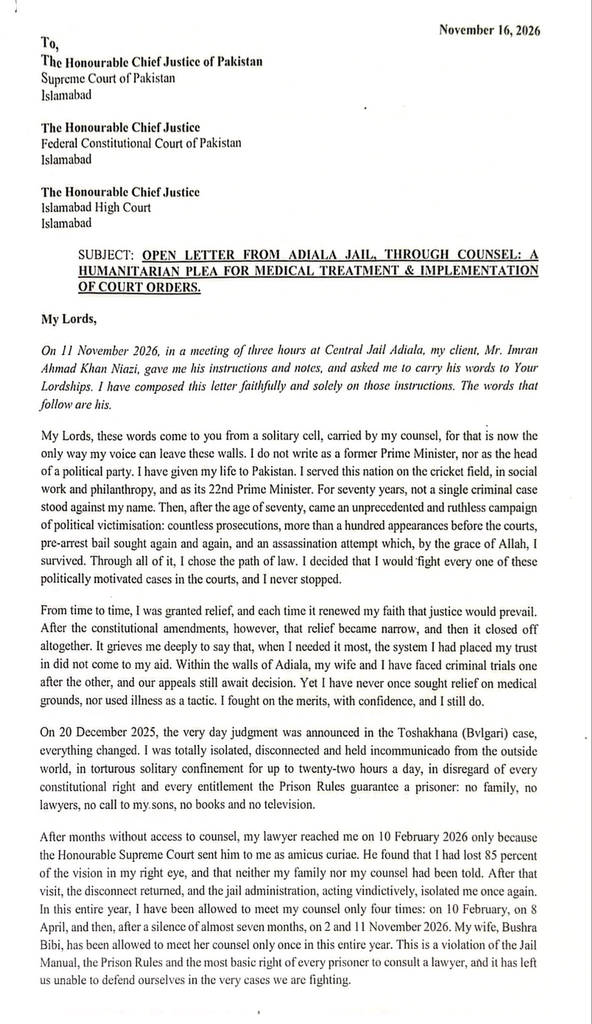
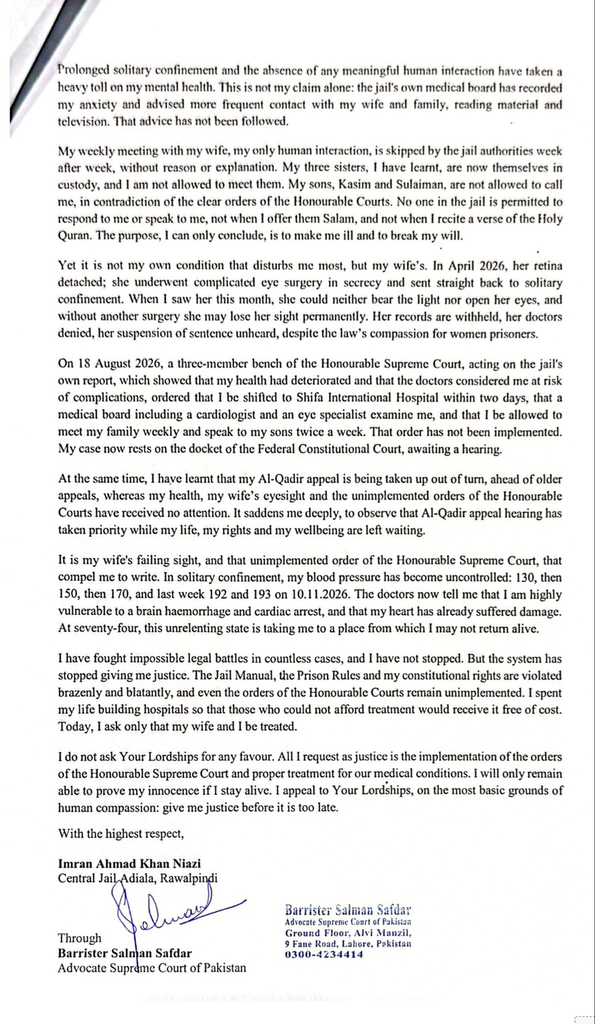
On 16 November 2026, Imran Khan issued an open letter addressed to the chief justices of the Federal Constitutional Court, Supreme Court and Islamabad High Court.
The letter was shared by his lawyer, Barrister Salman Safdar, after a meeting at Adiala Jail on 11 November.
Khan described his imprisonment, medical condition and restrictions on his contact with family and lawyers. He said he had been held in solitary confinement for up to 22 hours a day since 20 December 2025.
He said his right eye had lost 85 per cent of its vision and that his blood pressure had reached 192 or 193. He alleged that medical warnings about the possibility of a brain haemorrhage or cardiac arrest had not been treated with the urgency required.
He referred to the Supreme Court’s order of 18 August 2026 directing his transfer to Shifa International Hospital and the establishment of a medical board. He said the order had not been implemented in the manner directed.
He also raised concerns about Bushra Bibi’s eyesight. He said she had suffered a retinal detachment in April 2026 and undergone complicated surgery before being returned to solitary confinement. He said she was now at risk of permanent loss of eyesight without further treatment.
Khan also complained about restrictions on his access to family members, lawyers and his sons. He said that his medical records and his wife’s medical records had not been made available as required.
The letter contained a direct warning about his life.
“I may not return alive.”
The words were a plea to the country’s highest judicial authorities. They were also a challenge to the constitutional institutions responsible for protecting people in custody.
A prisoner does not lose the right to life because of a criminal conviction. A prisoner does not lose the right to medical treatment because he is politically unpopular. A prisoner does not lose the right to communicate with family because his political movement is in conflict with the government.
The courts must ensure that their orders are implemented. The authorities must provide the medical treatment required. The prison administration must maintain humane conditions and allow lawful access to lawyers and family members.
The government may dispute Khan’s account. It may present medical records and its own explanation of prison facilities. Those records should be placed before the courts and examined independently. The issue cannot be resolved through political statements.
The responsibility of the state is clear: protect the life of every person in its custody.
33. Imran Khan’s record in cricket, philanthropy and public life
The political and legal controversies surrounding Imran Khan should not erase the public record of his life before imprisonment.
Khan first became internationally known through cricket. As captain of Pakistan’s national cricket team, he led the country to victory in the 1992 Cricket World Cup. His leadership during the tournament became one of the defining moments in Pakistan’s sporting history.
He was an internationally recognised all rounder and one of the most prominent cricketers of his generation. His sporting career gave him a public platform that he later used to pursue philanthropic and political projects.
Following the death of his mother from cancer, Khan established the Shaukat Khanum Memorial Cancer Hospital and Research Centre. The hospital opened in Lahore in 1994. Its mission was to provide cancer treatment to patients who could not afford the cost of care.
The institution became one of Pakistan’s most recognised charitable healthcare projects. It expanded its services and developed a national reputation for cancer treatment and research.
Khan later established Namal University in Mianwali. The project aimed to expand access to higher education for students from less privileged backgrounds and provide opportunities outside Pakistan’s largest urban centres.
In 1996, he founded Pakistan Tehreek e Insaf. The party initially struggled to establish itself as a major political force. Over time, it developed into one of Pakistan’s largest political movements and formed governments at the federal and provincial levels.
As prime minister from 2018 to 2022, Khan’s government introduced and expanded social protection programmes. These included the Ehsaas programme and the Sehat Sahulat health insurance initiative. His government also pursued the Naya Pakistan Housing Programme and other development and welfare projects.
His administration faced substantial economic challenges, inflation, political opposition and disagreements over governance. His record as prime minister remains open to public scrutiny and debate.
But his cricket achievements, philanthropic work and political career are part of the country’s history. They help explain why his imprisonment has remained such a consequential political issue and why millions of people continue to follow his fate.
34. Pakistan’s future must belong to its people
Pakistan’s current crisis is not simply a dispute between one political party and one government. It concerns the constitutional relationship between elected representatives, the military establishment, the judiciary and the citizens whose rights all these institutions are required to protect.
The country needs a credible investigation into the events of 9 May 2023. It needs a complete account of the deaths and alleged use of force during the November 2024 protests. It needs a national register of deaths in custody and independent investigations into allegations of torture and medical neglect.
It needs answers for families searching for missing relatives in Balochistan and Khyber Pakhtunkhwa. It needs protection for journalists and human rights defenders. It needs elections in which every vote is counted accurately and every result can be independently verified.
It needs a judiciary capable of reviewing the actions of every public institution. It needs Parliament to exercise its constitutional responsibilities. It needs provincial governments to operate according to their democratic mandates. It needs the armed forces to serve within their constitutional role.
No political leader is above the law. No government is above the law. No military officer is above the law. No intelligence agency is above the law. The Constitution must apply equally to everyone.
The deaths of citizens, the disappearance of journalists, the detention of political opponents and the denial of medical treatment to prisoners cannot become normal features of national life.
Pakistan has endured military coups, political instability, terrorism, economic crises and constitutional breakdowns. Its people have repeatedly demanded a country in which the law protects everyone and political power comes from the ballot rather than pressure or coercion.
The hope is that Pakistan will find its way again. That democracy will be restored in substance and not merely in name. That political disagreements will be resolved through elections and constitutional institutions. That families will no longer have to search for missing relatives and prisoners will receive the medical treatment and legal protection guaranteed to them.
The future of Pakistan belongs to its people.
Summary
An in depth investigation into Pakistan’s political and constitutional crisis, tracing the events from the removal of Imran Khan’s government in April 2022 to his imprisonment and November 2026 warning that he may not return alive. The report examines the role of the military establishment under General Qamar Javed Bajwa and General Asim Munir, the events of 9 May 2023, allegations of political persecution, the disputed 2024 general election, deaths during the November 2024 crackdown, deaths in prison, enforced disappearances, pressure on journalists, military trials of civilians and constitutional amendments that have reshaped the balance of power.
It also examines the situation in Balochistan and Khyber Pakhtunkhwa, the use of force against civilians, the growing military role in economic and mineral policy and the international human rights concerns surrounding Imran Khan’s detention. The report concludes by examining Khan’s record in cricket, philanthropy and public service before considering the future of democracy, constitutional accountability and human rights in Pakistan.
Sources and References
Imran Khan’s imprisonment and medical condition
- Dawn: Imran Khan’s open letter to the chief justices, 16 November 2026
- Al Jazeera: Imran Khan’s appeal to Pakistan’s top judges, November 2026
- Dawn: Lawyers’ affidavits concerning Imran Khan’s prison meeting
- Dawn: Supreme Court order concerning Imran Khan’s medical treatment
- Dawn: Islamabad High Court ruling on solitary confinement
Removal of government and political developments
- Supreme Court of Pakistan: Judgment on the April 2022 constitutional crisis
- Library of Congress: Pakistan Supreme Court ruling on the no confidence motion
- Dawn: General Asim Munir assumes command as army chief
9 May 2023 and military trials
- Dawn: Punjab Forensic Science Agency report on May 9 CCTV footage
- Supreme Court: October 2023 judgment on civilian military trials
- Dawn: Supreme Court ruling on civilian military trials, May 2025
Prison conditions and deaths in custody
- National Commission for Human Rights: Prison Data Report 2024
- United Nations: Pakistan’s response to the Committee against Torture
2024 general election and disputed results
- Commonwealth Observer Group: Final Report on Pakistan’s 2024 General Election
- PATTAN and Coalition 38: Audit of Islamabad National Assembly constituencies
November 2024 protest and deaths
- Human Rights Commission of Pakistan: Independent inquiry into the November 2024 PTI protest
- HRCP: Full fact finding report on the November 2024 protest
Constitutional amendments and military authority
- Senate of Pakistan: Legislative records and constitutional amendments
- Senate of Pakistan: 27th Constitutional Amendment text
- Constitution of Pakistan: Article 6, High Treason
- Constitution of Pakistan: Article 243, Command of Armed Forces
- International Commission of Jurists: Concerns over the 26th Constitutional Amendment
Mineral resources and military economic involvement
Balochistan and Khyber Pakhtunkhwa
- Human Rights Commission of Pakistan
- Human Rights Council of Balochistan: State of Human Rights in 2025
- Amnesty International: Civilian deaths in Khyber Pakhtunkhwa drone strikes
- Dawn: Governor’s Rule and emergency in Khyber Pakhtunkhwa
Journalists and political figures
- United Nations: Special Procedures communication concerning Arshad Sharif
- Amnesty International: Imran Riaz Khan
- Dawn: Shahzad Akbar reports attack in the United Kingdom
United Nations human rights findings