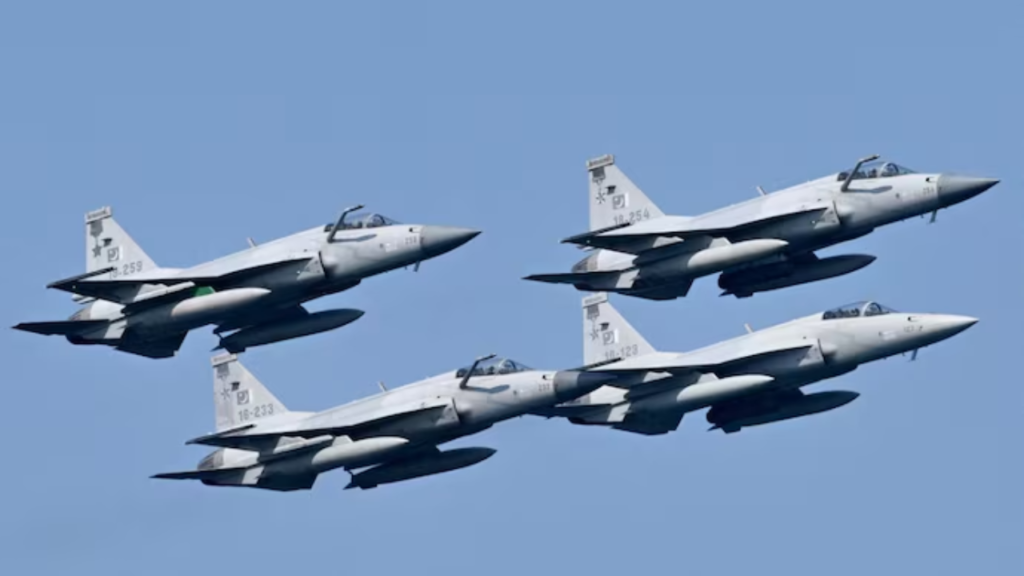
Pakistan’s government has rejected a New York Times report that its air force is hitting Houthi targets, while officials confirm troops are in Saudi Arabia under a new defense pact.
Reports of Pakistan Houthi strikes in Yemen drew a firm denial from Islamabad on Thursday after The New York Times said Pakistan Air Force fighter jets were being used against the Houthis. The claim arrives as Houthi attacks on Saudi Arabia intensify and the Mecca Joint Defense Agreement is put to its first real test.
What the Pakistan Houthi Strikes Report Claims
The New York Times quoted a senior Pakistani military official, speaking anonymously, who said Pakistan Air Force jets were being used in strikes on the Houthis, according to ThePrint’s account of the report. A second official said Pakistan’s role would focus on reducing the Houthi drone and missile threat through air support, not on a ground offensive inside Yemen. Pakistan Observer noted the report did not clarify whether the aircraft operated from Saudi territory or from inside Yemen.
Islamabad’s Response to the Report
Pakistan Today reported that the Ministry of Information and Broadcasting called the story “fake and fabricated” in a post on X. The ministry urged international media to avoid speculative reporting on how Pakistan’s forces might be used under the Mecca Joint Defense Agreement, and said the relevant authorities would provide details if any deployment took place. The Defense News reported that Pakistan has not officially confirmed any offensive Air Force operations inside Yemen.
Is Pakistan Fighting in Yemen?
Officials have confirmed a presence in Saudi Arabia but not combat in Yemen. Arab News reported that military spokesman Ahmed Sharif Chaudhry said Pakistani soldiers are serving in the kingdom in “multiple capabilities and domains.” Defense Blog reported that he told CNN any involvement would be defensive.
Defense Minister Khawaja Asif told Geo News, as quoted by Al Jazeera, that Pakistani and Turkish forces were “playing a supporting role” and were involved in reconnaissance, while Saudi forces carried out the combat.
The Express Tribune reported that the ministry’s statement followed a Reuters report from October 2. Citing a Pakistani official, Reuters said Pakistan had deployed 30,000 to 40,000 troops to Saudi Arabia to help defend its land borders and intercept drones and missiles. Reuters also said Islamabad had not decided to send troops into Yemen in a fighting capacity. The ministry called that report speculative.
Mecca Joint Defense Agreement Activated
Pakistan, Saudi Arabia and Turkey signed the pact on August 7. Khaama Press, citing Reuters, said it treats an armed attack on one member as an attack on all three. Al Jazeera reported that an emergency meeting in Riyadh on Monday brought the pact into force for the first time and agreed to send Pakistani and Turkish forces to the kingdom. The outlet quoted coalition spokesman Turki al-Malki as saying 100 fighter jets were backing a counteroffensive by Yemen’s recognized government.
Casualties From Houthi Attacks on Saudi Arabia
Saudi Arabia’s civil aviation authority said three people were killed and 36 injured in attacks on Abha International Airport and King Khalid International Airport on October 6 and 7, according to ANI. Two people died and 28 were injured at Abha. At King Khalid in Riyadh, a Sudanese resident was killed and eight were hurt, including five Saudis, two Egyptians and a Pakistani national, Gulf Business reported.
The Associated Press reported that the Houthis claimed both attacks. It also said Houthi spokesman Yahya Saree asserted, without evidence, that the jets used had taken off from Saudi bases. CNN reported a new wave of strikes on Thursday, with verified images showing smoke over Terminal 4 at King Khalid airport. The United Nations says almost 1,000 people have died and more than 200,000 have been displaced in the latest fighting.
None of the reports reviewed mention Pakistani military casualties.