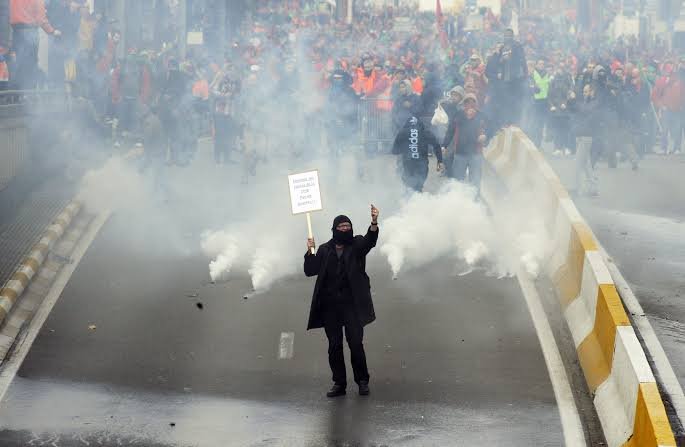
Student protests have spread to Belgium as demonstrations over education conditions and government reforms continue to intensify across Europe, with France witnessing the largest wave of disruption in recent days and universities in the United Kingdom facing prolonged strikes and disputes over cuts.
In Belgium, hundreds of students gathered outside schools in several cities on Monday, October 5, with the most serious disturbances reported in Liège. Police made 16 administrative arrests after demonstrations against education reforms and budget reductions escalated into incidents of vandalism and clashes with authorities.
The demonstrations in Belgium are linked primarily to concerns over reforms and funding reductions affecting education. In Liège, students blocked school entrances and gathered in the city centre, while protesters also displayed banners opposing a tuition fee of €1,200. Authorities reported fires involving scooters and waste containers in parts of the region, while fireworks and firecrackers were also used during disturbances in Charleroi.
Belgian authorities said police discovered glass bottles and pieces of fabric among materials carried by some protesters that could potentially have been used to make Molotov cocktails. Officials said, however, that no flammable substances were found. The discovery has added to concerns over the possibility of further escalation as demonstrations continue.
The Belgian developments come as France experiences a much broader student mobilization. The French movement began in the Paris region in September before spreading to cities across the country. Students have protested overcrowded classrooms, shortages of teachers, deteriorating school buildings, difficult schedules and wider concerns about education resources.
By Monday, between 400 and 500 French secondary schools were expected to be fully or partially closed. France’s Education Ministry said 24 of the affected schools had been burned or vandalized and reported that 78 education staff members had been injured since the beginning of the unrest. The Interior Ministry said nearly 5,000 arrests had occurred since the protests began.
The movement has also expanded beyond secondary schools. University students have joined demonstrations in France, with access blocked at dozens of campuses. Earlier reports also recorded demonstrations and damage at schools in Liège, showing that the unrest had already crossed the French Belgian border before Monday’s larger demonstrations.
In the United Kingdom, universities are experiencing a separate wave of disruption connected to financial pressures, staff reductions and industrial disputes. Staff at universities including Edinburgh, Dundee and Nottingham have undertaken or announced strike action, with students facing cancelled teaching and uncertainty over parts of the academic year. At Edinburgh, staff are engaged in a five week strike over planned cuts and potential job losses, while Nottingham has announced further industrial action extending from October into December.
The issues driving the protests are not identical across the three countries. In France, students have focused heavily on classroom conditions, staffing and school infrastructure. In Belgium, the immediate demonstrations are centred on education reforms, funding and tuition related concerns. In Britain, the current disruption is largely connected to university finances, staff employment and industrial action.
Nevertheless, the developments point to growing pressure on education systems across parts of Western Europe. What began as localized disputes has in several cases expanded into wider national mobilizations, bringing students, teachers, university staff and government authorities into increasingly tense confrontations.
The immediate question is whether Belgium’s demonstrations remain concentrated around education reforms or develop into a broader student movement. In France, further mobilization has already been announced, while in Britain university strikes are scheduled to continue at several institutions.
For now, the European education protests remain driven by different national grievances rather than a single unified movement. However, the rapid spread of demonstrations across borders has placed education funding, staffing and access at the centre of a wider political debate over the future of public education.