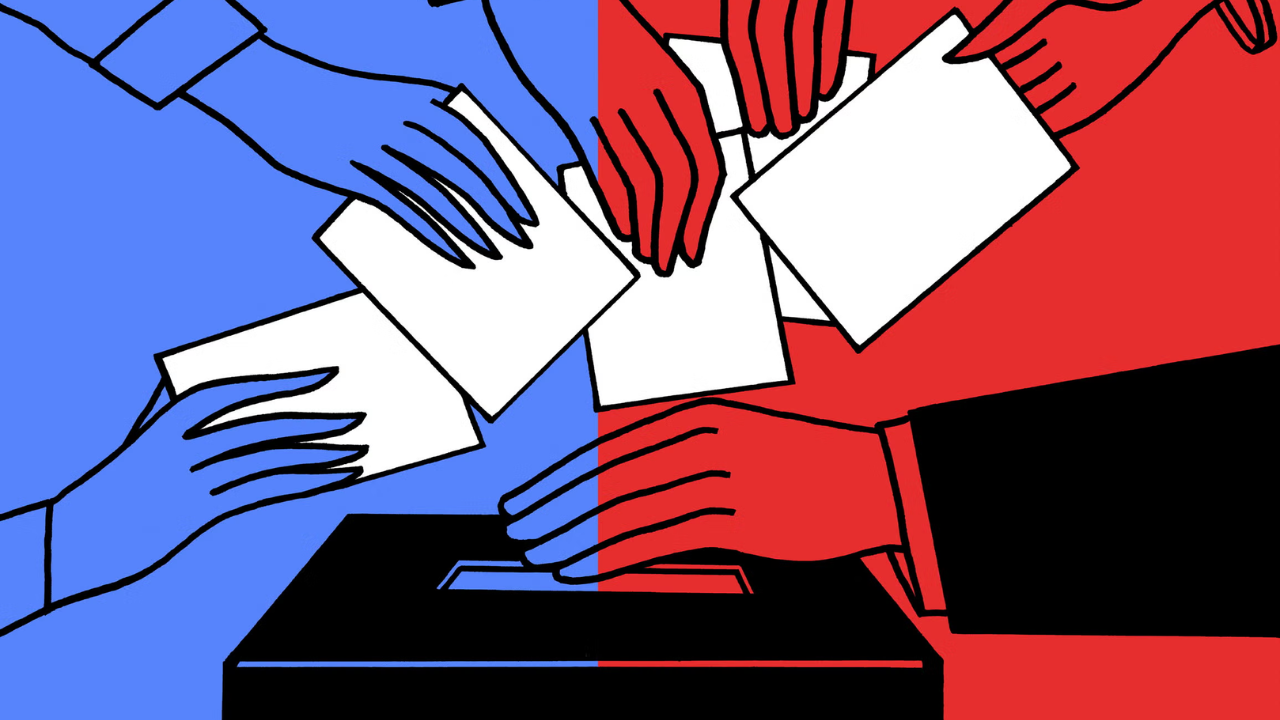
Democracy is supposed to be the voice of the people, and they have the right to use the ballot box to ensure improvements in their schools, reliable medical care, clean water, paved streets and fair economic opportunities. But in every election there are people who vote and never see their lives change. They may be assumed to be voting against their own interests. Or maybe their interests are not even born yet. The deeper reality is far more troubling: too often, democracy becomes a carefully rehearsed illusion in which the ruled participate in sustaining the very structures that keep them deprived.
The logic of class power, as captured by a Marxist perspective, helps in understanding the dynamics of sustaining inequality when deprivation looks normal, inevitable or even good. Antonio Gramsci goes further, explaining that the power of dominant groups lies not just in control but also in the consent they gain from those they rule. At the same time, Louis Althusser addresses the working of ideology in institutions and everyday life, turning people into subjects who accept certain beliefs and social relationships as natural. The same theme of internalized domination is found in Ama Ata Aidoo’s Our Sister Killjoy. Aidoo uses Sissie’s experiences with colonial and neo-colonial thinking to examine how domination works not only as a force from the outside but also as one from within, shaping the world and the self. Her novel deals with a different period and culture, but it examines the colonized mind, a literary parallel to the way power becomes ingrained in people’s minds.
This conditioning can be seen in real life in my own village. In the middle of an election campaign, a religious leader from the area gave them a tightrope choice: vote for the party he favored or face Jahannam (hell) and lose Jannah (heaven). Another prominent cleric went even further and stated that voting for his party was a religious duty, even in the sacred seclusion of the last ten days of Ramadan (Itikaf). His verdict was that if a voter left the mosque and voted for another party, Allah would be displeased with him, while if he left the mosque and voted for the cleric’s party, he would be rewarded.
These were not typical political appeals but rather civic obligations put to a religious test. To the voter who sees a local preacher as a key spiritual leader, the ballot box might be open, but the logic behind his vote can be severely limited. From the outside, it is considered irrational, but from the inside, it is obedience to heaven.
If one side is being endorsed by religion and the other side is being condemned, then there is no room for material questions. Alongside the threat of eternal consequences, the importance of healthcare, education, livelihoods and civic dignity is lost. Rather than asking “what will make their lives better,” voters are asked “which political choice will keep their place before God?” This is the practice of hegemony: political commitment is integrated into a person’s moral compass, and opposition seems less like a political argument than a betrayal.
Nor is this only the result of illiteracy. We tend to believe that people with formal education are immune to manipulation, but a university education does not necessarily mean an independent mind. Well-informed citizens can also stand by the status quo where identity and social belonging are concerned. Education is transformative only when it instills in people the habit of questioning information: Who is saying what? For whose benefit are they saying it? What is the evidence for their arguments? If this habit of critical questioning is omitted, schools can produce followers, not free citizens.
Ordinary voters do not act in a vacuum, of course. Anyone who uses faith for political ends is responsible for reducing others’ freedom of thought, and the state is responsible as well. When public institutions fail to deliver reliable services and to provide accessible civic information and basic security, local power brokers can step in to fill the void. Their influence can be far greater than that of any political program.
To be sure, voting against one’s material advantage is not in itself immoral or irreligious, because moral and religious duty is not limited to material welfare. Democracy is undermined not by people’s convictions but by the weaponization of those convictions, when fear takes the place of independent thinking and when dissent is seen as betrayal.
But in the end, criticism must also be directed at the people as citizens. Religion should never be used as a means to stifle questions or to demand complete obedience. Islam recognizes the value of reason, reflection and moral discernment. We must not give up judging for ourselves just because someone wants to wrap political self-interest in religious language. No freedom can be gained from elections by a mind held captive by fear. If citizens cannot question those who seek their allegiance, the right to vote is not worth much. True democracy does not start at the polling station. It starts when people can think, question and vote without being manipulated, when they can enter the polling station freely.