France has witnessed one of its largest waves of student and education protests in decades, with more than 250,000 people taking part in nationwide demonstrations over deteriorating schools, teacher shortages, overcrowding and educational inequality.
The protests have now moved beyond a dispute over education funding.
Clashes between demonstrators and police, mass arrests and allegations of excessive force have transformed the movement into a wider confrontation over inequality, public spending and the government’s response to an increasingly angry younger generation.
France’s Interior Ministry said approximately 256,000 people participated in demonstrations across the country, including about 56,000 in Paris.
Organisers claimed the true nationwide figure was substantially higher.
Schools become the centre of a wider political crisis
The movement began with school blockades and student demonstrations before spreading across France.
Students, teachers and parents have complained about deteriorating infrastructure, overcrowded classrooms, teacher shortages and inadequate resources.
In poorer communities, education inequality has become especially visible.
Schools serving disadvantaged areas often face greater pressure while having fewer resources available to address those problems.
The protests therefore represent more than a demand for additional education spending.
For many demonstrators, the dispute is about whether public institutions are still capable of providing equal opportunities to citizens regardless of their economic background.
Police response becomes a second crisis
The government’s response has intensified the controversy.
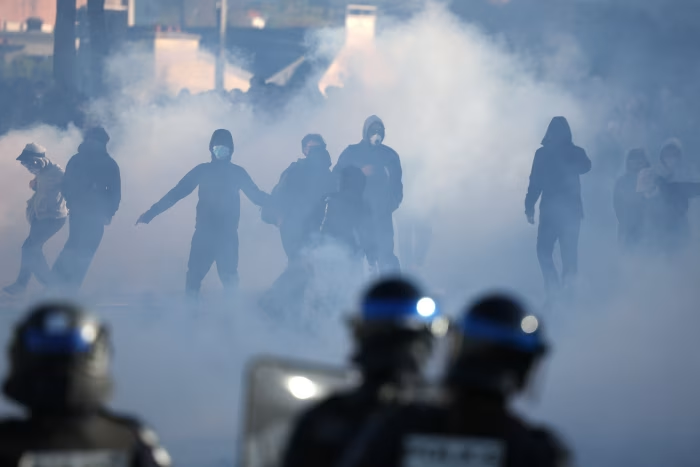
French riot police used tear gas during clashes in Paris as some demonstrations became confrontational.
Authorities have reported thousands of arrests since the movement began, with a significant number involving minors.
The use of force has attracted particular attention following injuries involving young protesters.
Rights groups and protesters have questioned whether the police response is proportionate, particularly when demonstrations involve teenagers.
The government has defended public order operations while Prime Minister Sébastien Lecornu has acknowledged concerns about the education system and promised measures addressing school infrastructure and other problems.
That response has not ended the demonstrations.
Why the movement matters politically
The timing is significant.
France is moving toward another presidential election cycle, and the education protests are emerging at a moment when economic inequality, public spending and the cost of living are already politically sensitive issues.
Both the political left and right are attempting to interpret the demonstrations through their own ideological frameworks.
Left wing groups have focused on inequality and public investment.
Right wing politicians have emphasized public order, discipline and violence during demonstrations.
For the students themselves, however, the immediate complaint is considerably simpler.
They want functioning schools.
A generation losing confidence
The protests also reveal a deeper generational divide.
Young people entering adulthood in France face a combination of high housing costs, difficult employment prospects, pressure on public services and growing concerns about the quality of education.
Education is particularly important because it is traditionally presented as one of the principal mechanisms through which people can improve their economic position.
When schools themselves become symbols of inequality, that promise becomes harder to sustain.
Students from wealthy areas can often compensate for weaknesses in public education through private tutoring, better housing conditions and access to additional resources.
Students from poorer communities have fewer alternatives.
That creates a system in which educational inequality can reproduce economic inequality.
The government’s dilemma
The government now faces two competing pressures.
It needs to respond to legitimate complaints about education without allowing demonstrations to become violent or encouraging further disruption.
At the same time, an overly aggressive police response risks transforming a school funding dispute into a much broader confrontation between young people and the state.
That transformation may already be underway.
Images of riot police confronting students can travel across social media far faster than policy announcements about school budgets.
For a generation that already distrusts traditional political institutions, the visual contrast is powerful.
A teenager demanding better classrooms sees police in riot equipment.
That can become a political story much larger than the original complaint.
The cost of maintaining the status quo
France is also confronting a familiar dilemma seen across Europe.
Governments face increasing demands for public spending while simultaneously operating under significant fiscal constraints.
Education competes with defence, healthcare, pensions, infrastructure and other priorities.
The political question is therefore not simply whether France needs better schools.
It is whether the government is willing to redirect sufficient resources toward them.
That decision has consequences beyond education.
Underfunded schools can produce poorer educational outcomes, greater social inequality and weaker economic mobility.
The costs eventually appear elsewhere in society.
France’s protest culture is changing
France has a long history of mass protest movements.
But the current mobilisation is notable because students have become one of the central forces behind it.
School blockades and youth demonstrations can create a political crisis quickly because they disrupt daily life while placing the government in an uncomfortable position.
Authorities must respond without appearing to punish young people for demanding improvements to their future.
That balance is becoming increasingly difficult.
The government can promise reforms.
It can increase security around schools.
It can investigate incidents involving police.
But if students continue to believe that their schools are being sacrificed to broader budgetary priorities, the protests are unlikely to disappear simply because officials announce another package of reforms.
France’s education crisis has therefore become something larger.
It is increasingly a confrontation over what the state owes its younger citizens and how far a government can go in defending an existing system before the people living under that system demand fundamental change.
– Tamrah News Europe