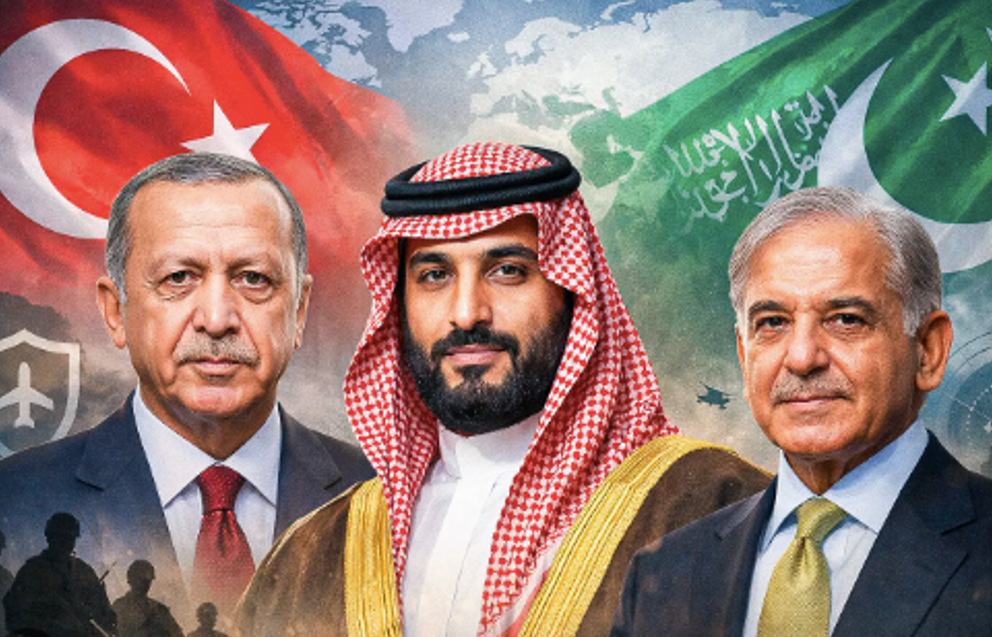
Pakistan and Türkiye are moving into a new military phase with Saudi Arabia as the Makkah Defence Alliance begins the practical implementation of its collective defence commitments amid an expanding Saudi backed offensive against the Houthis in Yemen.
Tamrah News has learned that approximately 12,000 Pakistani troops have now been deployed to Saudi Arabia as part of the rapidly expanding military arrangement, with additional Pakistani personnel expected to join. Sources familiar with the deployment say the overall Pakistani force could eventually reach a ceiling of approximately 30,000 soldiers.
The development comes as Saudi backed Yemeni government forces launch a major offensive around Bab Al Mandab and Mocha, supported by an extensive Saudi air campaign. Reuters reported on October 5 that government forces had advanced rapidly around the strategic strait and pushed Houthi forces away from several coastal positions.
At the same time, Saudi Arabia, Pakistan and Türkiye agreed in Riyadh on October 5 to immediately implement the collective defence commitments of the Makkah Alliance and take measures to provide agreed military forces and capabilities for rapid deployment in Saudi Arabia.
The combination of the military deployment, the emergency alliance meeting and the battlefield escalation marks a significant change in the regional security architecture.
12,000 Pakistani Troops Are Already in Saudi Arabia
Information reviewed by Tamrah News indicates that the Pakistani deployment has already reached approximately 12,000 personnel, with the force expected to expand further under the new defence framework.
The personnel were moved through multiple Pakistani airports, including Islamabad, Peshawar, Lahore, Multan and Karachi, according to information provided to Tamrah News. Military equipment was transported separately through military transport aircraft, while aviation assets were handled through separate military channels.
The scale of the deployment represents a substantial expansion of Pakistan’s military presence in Saudi Arabia.
The ultimate force ceiling is understood to be approximately 30,000 Pakistani soldiers, although the pace and composition of further deployments will depend on operational requirements and the arrangements agreed between Islamabad and Riyadh.
The public statement issued after the October 5 Makkah Alliance meeting does not publish troop numbers. It does, however, confirm that the three countries agreed to provide designated military forces and capabilities and ensure their rapid deployment to Saudi Arabia.
That official language provides the public framework surrounding the deployment while the 12,000 figure reported to Tamrah News provides the operational scale.
Pakistan Began Preparing Its Troops Before the Alliance Was Activated
The deployment did not begin overnight.
Sources familiar with preparations inside Pakistan told Tamrah News that Pakistani military units had already been preparing for an expanded Saudi role during the period when Islamabad was negotiating its security arrangements with Riyadh.
According to information reviewed by Tamrah News, platoon commanders were briefed that Pakistan would increasingly depend on Saudi Arabia for military deployment opportunities and that personnel could be sent to the kingdom for extended assignments.
The financial aspect was also discussed among troops.
Sources said personnel were aware that overseas deployment could provide significantly higher financial compensation than normal domestic service, with payments structured according to rank and individual deployment status.
Tamrah News has not independently established the exact payment schedule or the amount allocated to individual soldiers and officers. The financial arrangements should therefore be treated separately from the confirmed deployment itself.
For many Pakistani personnel, however, the prospect of overseas deployment has reportedly been welcomed because extended assignments in Saudi Arabia can provide an opportunity to earn substantially more money and support families at home.
Language Training Was Part of the Preparation
One of the more unusual elements of the preparations concerns language training.
Sources told Tamrah News that selected Pakistani personnel were sent to the National University of Modern Languages in Islamabad for linguistic preparation before their expected Saudi assignments.
The reported purpose was operational communication.
Pakistani personnel working alongside Saudi military formations would need to communicate effectively with Saudi personnel at different command levels, particularly in circumstances where English could not be relied upon as the primary working language.
The National University of Modern Languages has long provided language training for Pakistani government and military institutions, making the reported use of the institution consistent with the broader preparation process.
Tamrah News has independently established the number of soldiers who received this training and the precise languages assigned to each group.
Pakistan Had Already Sent Thousands of Troops and JF 17 Aircraft
The current deployment also follows an earlier Pakistani military buildup inside Saudi Arabia.
Reuters reported in May that Pakistan had deployed approximately 8,000 troops to Saudi Arabia during the Iran war, alongside a fighter aircraft squadron, drone squadrons and a Chinese HQ 9 air defence system. Reuters also reported that approximately 16 Pakistani JF 17 fighter aircraft were part of the deployment and that the personnel and equipment were funded by Saudi Arabia.
That deployment is important because it establishes that Pakistan’s military presence in Saudi Arabia was already substantial before the October escalation.
The current 12,000 figure therefore represents an expansion of an existing Pakistani military footprint rather than the creation of an entirely new presence.
It also means Pakistan already has personnel familiar with Saudi bases, Saudi military procedures and the operating environment in the kingdom.
Chinese Air Defence Adds Another Layer
The reported presence of Chinese manufactured HQ 9 air defence equipment in Saudi Arabia adds another significant component to the Pakistani deployment.
The system is designed to provide long range air defence and could be relevant to Saudi Arabia’s efforts to defend its cities, military facilities, energy infrastructure and other strategic sites from missiles and drones.
The Houthi threat has increasingly involved missiles and unmanned systems capable of reaching Saudi territory.
This makes air defence one of the most immediate areas in which Pakistani military personnel could contribute to Saudi security without necessarily conducting offensive operations inside Yemen.
The distinction matters.
A Pakistani air defence deployment can directly support Saudi Arabia’s collective defence commitments while remaining geographically based inside the kingdom.
Offensive operations inside Yemen would represent a substantially different level of Pakistani involvement.
JF 17 Production Has Also Accelerated
Tamrah News has also received information indicating that Pakistan accelerated production and preparation of JF 17 Thunder Block 3 aircraft during the broader security buildup.
The JF 17 Block 3 represents the most advanced version of Pakistan’s indigenous fighter programme and incorporates upgraded avionics, radar and weapons capabilities.
Pakistan’s earlier deployment of JF 17 aircraft to Saudi Arabia demonstrates that the platform is already part of the bilateral military relationship.
However, Tamrah News has not found sufficient independent evidence to establish that Pakistani JF 17 aircraft have conducted offensive strikes against Houthi targets inside Yemen on October 5.
That distinction will remain important as the military campaign develops.
Turkish Military Capabilities Enter the Equation
Türkiye’s involvement adds another major dimension to the emerging alliance.
The Makkah Defence Alliance was established by Saudi Arabia, Pakistan and Türkiye, creating a three country security framework that combines Saudi financial and military resources with Pakistani manpower and aviation capabilities and Türkiye’s expanding defence industry.
The three countries held their emergency Strategic Political and Defence Committee meeting in Riyadh on October 5.
The committee agreed to move immediately toward practical implementation of collective defence commitments and to take the necessary measures to provide agreed military forces and capabilities for rapid deployment in Saudi Arabia.
Turkish Foreign Minister Hakan Fidan said after the meeting that the partners had discussed what support could be provided for Saudi Arabia’s defence while also discussing diplomatic options for resolving the Yemen crisis.
Türkiye’s drone capabilities are particularly significant.
The country has developed one of the world’s most prominent military drone industries and has extensive experience integrating unmanned aircraft into battlefield operations.
Tamrah News has also received information that Pakistani pilots and military personnel have undergone training involving Saudi and Turkish military platforms, including Turkish drones.
That element remains part of our investigation and has not been independently confirmed through public documentation.
The 30,000 Soldier Ceiling
The 12,000 Pakistani personnel currently deployed should not necessarily be understood as the final force.
According to information obtained by Tamrah News, the deployment framework allows for the Pakistani presence to expand toward approximately 30,000 soldiers.
Such a force would represent one of Pakistan’s largest overseas military commitments in decades.
The size would also substantially change the strategic significance of the Makkah Alliance.
A 30,000 strong Pakistani contingent would provide Saudi Arabia with a large pool of infantry, air defence, aviation support, logistics and other military capabilities while allowing Pakistan to maintain a significant military footprint inside the kingdom.
Whether the full ceiling is reached will depend on the evolution of the Yemen conflict, Saudi requirements and the political decisions taken by Islamabad.
The Parliament Question
The deployment also raises a major constitutional and political question inside Pakistan.
The Makkah Defence Agreement has been described by Islamabad as a collective defence arrangement. The October 5 statement explicitly says implementation and deployment will take place according to approved arrangements and the national legislation of the three countries.
The National had previously reported that parliamentary approval remained an important issue for both Pakistan and Türkiye in relation to ratification of the pact.
The distinction between deploying forces to defend Saudi territory and deploying them into offensive operations inside Yemen could become particularly important if Pakistan’s military role expands.
A defensive deployment inside Saudi Arabia is one question.
Participation in combat operations across the border is another.
The political consequences for Islamabad could therefore become considerably larger if Pakistani forces begin direct offensive operations in Yemen.
Saudi Arabia Is Already Fighting a Major Yemen Campaign
While Pakistan and Türkiye prepare to expand their military role, Saudi backed Yemeni forces have already moved into a major offensive.
Reuters reported that Yemeni government forces advanced around Bab Al Mandab and Mocha, while Saudi aircraft provided extensive air support. Houthi forces reportedly withdrew from several coastal positions toward mountainous areas, although Houthi sources disputed the scale of the losses.
The Guardian reported that more than 100 Saudi fighter aircraft were involved in the campaign, with strikes targeting Houthi positions in several parts of Yemen.
Associated Press also reported that Saudi backed forces had recaptured several areas around Bab Al Mandab with support from more than 100 coalition aircraft.
The offensive is therefore already underway before the full military architecture of the Makkah Alliance has been deployed.
Why Bab Al Mandab Matters
Bab Al Mandab is one of the world’s most important maritime chokepoints.
The narrow waterway connects the Red Sea with the Gulf of Aden and forms a critical route for commercial shipping moving between the Indian Ocean and the Mediterranean.
Control of territory surrounding the strait has strategic consequences far beyond Yemen.
Any prolonged disruption could affect international shipping, energy markets, insurance costs and supply chains connecting Asia, Europe and the Middle East.
For Saudi Arabia, securing Bab Al Mandab also means limiting the Houthis’ ability to threaten maritime traffic and maintain pressure on regional shipping routes.
For the Houthis, control or influence over territory near the Red Sea provides strategic leverage against Saudi Arabia and its international partners.
That makes the current battle around Dhubab and Mocha considerably more important than a conventional territorial contest.
The Makkah Alliance Is Becoming Operational
The most significant development on October 5 is therefore not simply another Saudi air campaign.
It is the transition of the Makkah Defence Alliance from a newly signed agreement into an operational security structure.
Saudi Arabia, Pakistan and Türkiye have now formally agreed to implement their collective defence commitments and accelerate the provision and deployment of military forces and capabilities.
Pakistan’s approximately 12,000 personnel already deployed to Saudi Arabia provide the first major indication of the scale at which Islamabad can contribute.
With a potential ceiling of 30,000 soldiers, the Pakistani role could become considerably larger.
Türkiye’s contribution remains less clearly defined publicly, but Ankara has confirmed that military support for Saudi Arabia was discussed at the emergency meeting.
What Happens Next
The next phase will determine whether the Makkah Alliance remains primarily a mechanism for defending Saudi territory or becomes a direct multinational force operating against the Houthis inside Yemen.
For Pakistan, the decision carries major strategic consequences.
The country has longstanding military ties with Saudi Arabia, while also maintaining complex relations with Iran and a domestic political environment in which overseas military deployments can become highly sensitive.
For Türkiye, the conflict presents an opportunity to expand its regional military influence but also carries the risk of becoming directly involved in another Middle Eastern war.
For Saudi Arabia, the alliance provides additional manpower, military capabilities and political backing as the kingdom attempts to reverse Houthi territorial gains.
For Yemen, however, another multinational military escalation could deepen an already devastating humanitarian crisis.
The country has endured years of war, displacement and economic collapse. The renewed fighting around Bab Al Mandab, Mocha and Taiz risks opening another prolonged phase of conflict.
The deployment of 12,000 Pakistani troops, with the potential for the force to rise toward 30,000, therefore represents more than a bilateral Saudi Pakistan military arrangement.
It could become the first major test of whether the Makkah Defence Alliance can function as a genuine collective military organisation.
The battlefield around Bab Al Mandab may provide the answer.
– Tamrah News Editorail Investigations