Madrid housing protests have entered their third day after the eviction of 87-year-old Maricarmen Abascal from her home of more than seven decades. Hundreds of protesters have camped at Puerta del Sol, demanding stronger tenant protections amid rising rents and a shortage of housing. The eviction has become a focal point in Spain’s wider housing crisis.
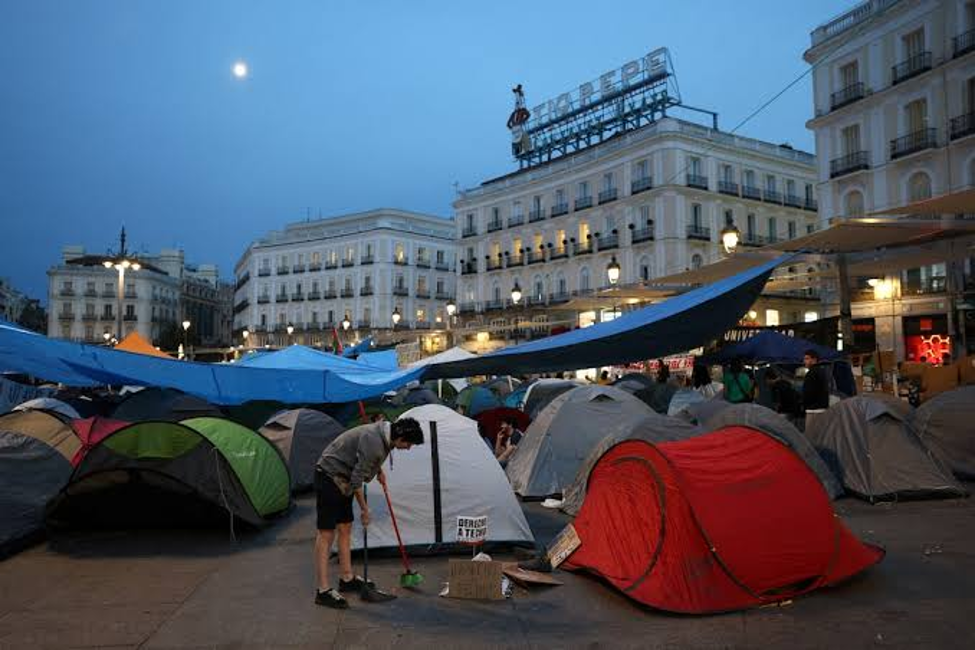
Housing protests in Madrid have entered their third day following the eviction of 87-year-old Maricarmen Abascal from the home where she had lived for more than seven decades.
Hundreds of protesters have gathered at Puerta del Sol, one of Madrid’s central public squares, setting up tents and demanding stronger protection for tenants. The demonstrations come as Spain faces rising rents, limited housing supply and growing concerns about housing affordability.
The protests intensified after Abascal was forcibly evicted from her Madrid apartment on September 23. She was taken from the property on a stretcher following an eviction order obtained by the investment fund that had acquired the apartment.
Why Are People Protesting in Madrid?
The eviction of Abascal has become a major focus of housing protests across Madrid. She had lived in the same apartment for more than 70 years, making her case particularly prominent amid wider concerns about rising rents and housing affordability.
According to reports, the property changed ownership in 2018. Abascal was reportedly offered an opportunity to purchase the apartment but could not afford it. The investment fund that later acquired the property subsequently increased the rent substantially, according to the Madrid Tenants’ Union.
The eviction followed several legal attempts to remove her from the property. Three previous eviction attempts had reportedly been blocked by the courts.
Her case has since drawn widespread public attention and has been used by housing campaigners to call for stronger tenant protections, action against unaffordable rent increases and changes to eviction procedures.
Protests Continue at Puerta del Sol
By Monday, hundreds of tents had been set up in the central Puerta del Sol square as demonstrators continued their campaign.
The encampment followed a large housing march through Madrid on Saturday. Tens of thousands of people participated in the demonstration, calling for stronger protections for tenants and measures to address rising housing costs.
Protesters have demanded measures including greater protection for renters, action against fraudulent housing practices and restrictions on evictions when tenants have no alternative accommodation.
The demonstrations have also brought attention to the broader difficulties faced by residents who struggle to keep up with increasing housing costs.
Spain’s Growing Housing Crisis
The protests are taking place amid a wider housing shortage in Spain. Rising rents and property prices have made it increasingly difficult for many residents to find affordable accommodation, particularly in major cities.
Reuters reported that rents in Spain have approximately doubled on average over the past decade, significantly outpacing salary growth.
Reuters also reported that Spain has a housing deficit of around 750,000 homes, according to the country’s central bank. Only about 120,000 homes are built each year, compared with much higher construction levels before the 2008 financial crisis.
Other reporting has also highlighted the limited supply of public rental housing in Spain. ABC News, citing the Associated Press, reported that public rental housing represents less than 2% of the country’s available housing supply, compared with a higher average across the European Union.
The shortage has contributed to growing pressure on the rental market as demand for housing continues to increase.
Government Faces Pressure Over Housing
The continuing protests have increased pressure on Spain’s government and regional authorities to address housing affordability and tenant protections.
Prime Minister Pedro Sánchez has pledged further action on the housing issue following the eviction. Reuters reported that Sánchez said on Sunday that his government was working to get a housing decree through parliament that would provide immediate relief for tenants.
The housing issue has also become a point of disagreement between Spain’s central government and regional authorities.
Madrid’s regional administration and the central government have exchanged criticism over responsibility for the housing situation and the failure to prevent the eviction.
Why the Eviction Has Become a Symbol
Abascal’s case has attracted widespread attention because she had spent more than seven decades living in the same home.
The circumstances surrounding her eviction have made her case a focal point for housing campaigners who say it reflects wider problems affecting long-term tenants and people struggling with Spain’s rising housing costs.
The Guardian reported that Abascal had been unable to afford a 230% rent increase demanded by the investment fund that had acquired her apartment. The investment fund did not respond to the Guardian’s request for comment.
Her eviction has therefore become connected to broader concerns about rising rents, limited housing supply and the difficulties faced by residents who cannot keep up with rapidly increasing housing costs.
The continuing demonstrations at Puerta del Sol show how the individual eviction has become part of a much wider debate over housing affordability and tenant protections in Spain.
Article by: Laraib Ali