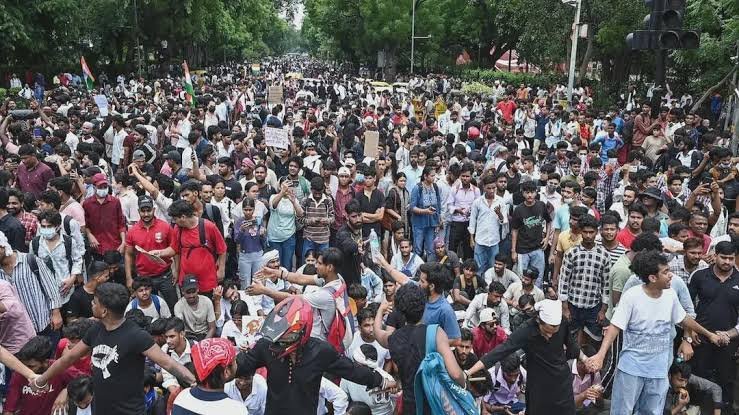
India’s political confrontation over electoral rolls intensified on Tuesday after police briefly detained opposition leaders, including Congress leader Rahul Gandhi, during a protest against the country’s election authorities.
The demonstrations in New Delhi centred on allegations surrounding the revision of electoral rolls and demands for the resignation of Chief Election Commissioner Gyanesh Kumar.
The opposition INDIA bloc argues that the voter list revision process could remove legitimate voters and undermine electoral representation.
The Election Commission rejects the accusations and maintains that the process is intended to identify duplicate, ineligible or otherwise problematic entries.
The dispute has now moved from institutional criticism into street politics.
Rahul Gandhi detained during protest
Rahul Gandhi joined opposition lawmakers and supporters in a march toward the Election Commission.
Police blocked the protesters with barricades.
Several opposition leaders were subsequently detained after attempting to move through the security cordon.
Gandhi was later released.
The images of the opposition leader being taken into police custody quickly spread across Indian media and social networks, turning an administrative dispute over electoral rolls into a major political confrontation.
Other opposition figures, including Priyanka Gandhi and leaders from regional parties, were also detained during the demonstrations.
What is the voter roll controversy?
At the centre of the dispute is the Special Intensive Revision of electoral rolls.
The process is designed to review voter registrations and identify names that authorities consider invalid, duplicated or otherwise ineligible.
The Election Commission argues that such verification is necessary to protect the integrity of elections.
Opposition parties say the process could have a disproportionate effect on vulnerable communities and could remove legitimate voters from electoral registers.
The political stakes are enormous.
India is the world’s largest democracy, and the credibility of its electoral rolls is fundamental to public confidence in elections.
If citizens cannot trust that eligible voters will remain registered, confidence in the electoral process can deteriorate even before voting begins.
Opposition claims go beyond one election
The opposition’s criticism is not limited to administrative procedures.
Opposition leaders have accused the Election Commission of failing to provide sufficient transparency and have demanded access to information that they say is necessary to independently verify the voter lists.
The allegations have become particularly politically sensitive because Prime Minister Narendra Modi’s Bharatiya Janata Party remains India’s dominant national political force.
The opposition argues that institutional safeguards become even more important when one political party has accumulated such significant electoral power.
The government and election authorities reject suggestions that the process is politically manipulated.
That disagreement is now being played out in public demonstrations rather than only through parliamentary debate.
Why the controversy matters
Electoral rolls rarely generate international headlines.
But they are among the most important pieces of democratic infrastructure.
An election does not begin on polling day.
It begins with determining who is eligible to vote.
If legitimate voters are removed, they may discover the problem only when attempting to cast their ballots.
If ineligible voters remain registered, political parties can argue that the system is vulnerable to manipulation.
That makes the accuracy and transparency of voter registration a fundamental issue rather than a technical administrative matter.
Police action raises another question
The detention of opposition lawmakers has created a second controversy.
Governments have the authority to regulate demonstrations and protect public buildings.
Opposition parties, however, have the right to protest and challenge institutions.
The confrontation therefore raises a familiar democratic question.
How much space should political opposition have to challenge an institution responsible for overseeing elections?
If authorities respond too aggressively, they risk strengthening the opposition’s argument that democratic institutions are becoming less tolerant of dissent.
If authorities permit unrestricted demonstrations around sensitive government buildings, they face their own public order concerns.
The balance is difficult.
The deeper battle is institutional trust
India’s voter roll dispute is ultimately about trust.
Trust in election officials.
Trust in political parties.
Trust in the accuracy of voter registration.
And trust that citizens will be allowed to participate in elections without discrimination.
Once that trust weakens, repairing it can be considerably harder than defending it in the first place.
The controversy is also likely to continue because both sides have strong incentives to maintain their positions.
For the opposition, the voter roll issue provides a powerful argument about institutional accountability.
For the government and election authorities, conceding the opposition’s allegations without evidence could undermine the credibility of the electoral system.
The result is a political stalemate in which every new detention, protest or allegation adds another layer of tension.
India faces a test of electoral transparency
The immediate demonstrations may eventually end.
The larger controversy will not disappear so easily.
India’s democracy depends not only on elections being held but on citizens believing that the electoral process is transparent and that legitimate voters can participate.
The Election Commission now faces intense scrutiny from opposition parties and civil society.
The government faces pressure to demonstrate that the voter revision process is fair.
And the opposition faces the equally important responsibility of substantiating its allegations with evidence.
The coming months will determine whether the dispute produces greater transparency or deeper political polarisation.
For now, the detention of opposition lawmakers has turned an argument about voter registration into a much larger national debate about who controls India’s democratic institutions and how much scrutiny those institutions should face.
– Tamrah News South Asia