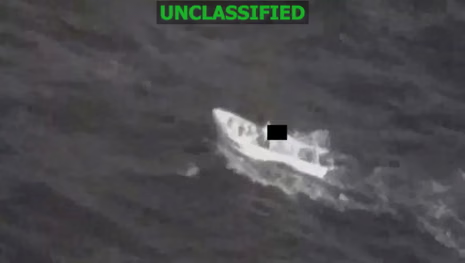
The United States military has carried out another strike against a boat it accused of participating in drug trafficking, killing four people in the Caribbean while providing no publicly available evidence that the vessel was carrying narcotics.
The latest operation has renewed questions about the legal basis, evidence and accountability surrounding the Trump administration’s expanding campaign against suspected drug trafficking vessels in the Caribbean and eastern Pacific.
The United States Southern Command said the vessel was operating along known trafficking routes.
But the military did not publicly identify the drugs allegedly being transported or provide evidence establishing that the four people killed were drug traffickers.
That gap between the government’s allegation and the evidence released to the public has become one of the most controversial aspects of the campaign.
A growing death toll
The latest strike brings the reported number of people killed in American attacks on suspected drug boats into the hundreds.
USNI News has tracked the total at approximately 238 deaths, while earlier Associated Press reporting put the figure at at least 235.
The campaign began in September 2025 and has expanded across maritime areas surrounding Latin America.
Washington describes the targets as narcotraffickers or narcoterrorists.
The administration argues that aggressive action is necessary to disrupt drug networks and protect Americans from the consequences of narcotics trafficking.
Critics argue that killing suspected traffickers without arrest, trial or publicly disclosed evidence raises fundamental questions about due process and international law.
The evidence problem
The central issue is not whether drug trafficking exists.
It does.
The question is whether the government can lawfully kill people at sea merely because officials believe they are involved in trafficking.
In the latest incident, the military released imagery showing an explosion involving a moving boat.
That footage does not independently establish what the vessel was carrying.
Nor does it establish the identities or criminal histories of those killed.
This creates a serious accountability problem.
When a government uses lethal military force, the public needs to understand why the people targeted were considered lawful targets.
Without evidence, the government’s description remains an allegation.
Why the distinction matters
A suspected criminal can ordinarily be arrested and prosecuted.
A military target can be attacked under circumstances governed by the laws of armed conflict.
Those are fundamentally different legal frameworks.
The Trump administration has increasingly described drug trafficking as a national security threat, creating an argument for military action.
But expanding the definition of a security threat does not automatically resolve the legal questions surrounding lethal force.
Human rights organisations have described the campaign as a series of extrajudicial killings.
The administration rejects that characterization.
The disagreement is now becoming one of the most significant unresolved legal questions surrounding the campaign.
A war on drugs without a battlefield
The geography of the operations makes the issue even more complicated.
These are not conventional battlefields.
The vessels are commercial or civilian looking boats operating in international or regional waters.
The people aboard may be suspected criminals, but the public is rarely given the opportunity to examine the evidence against them.
That creates a system in which military intelligence effectively becomes the accusation, prosecution and punishment.
There is no public trial.
There is no defence lawyer.
There is no judge reviewing the evidence before lethal force is used.
That is precisely why human rights organisations are demanding greater scrutiny.
The larger question of effectiveness
There is also a practical question.
Does destroying boats reduce the supply of drugs entering the United States?
The administration argues that the strikes disrupt trafficking networks.
But the available evidence is more complicated.
USNI News has noted that American overdose deaths had already been declining before the boat strike campaign began.
The relationship between maritime strikes and drug availability therefore requires independent evaluation rather than political assertion.
If the government is going to kill people in the name of combating narcotics, it should be able to demonstrate that the policy actually achieves its stated objective.
Otherwise, the campaign risks becoming a permanent military operation with an uncertain measurable benefit.
Congress faces a responsibility
The expanding campaign also raises questions about congressional oversight.
Military operations involving lethal force require democratic accountability.
Congress has constitutional responsibilities concerning war powers, military funding and executive authority.
If the executive branch can repeatedly conduct lethal strikes against suspected criminals without releasing evidence or obtaining meaningful oversight, the precedent could extend far beyond the current drug campaign.
Today’s target is a suspected smuggler.
Tomorrow’s justification could involve another category of alleged security threat.
That is why the legal framework matters.
The people on the boats
There is another dimension that is often lost in the official language.
Every military statement begins with a category.
Drug trafficker.
Narcoterrorist.
Smuggler.
But behind those labels are human beings whose identities and circumstances are often unknown to the public.
If the government is correct, the people killed may have been involved in serious criminal activity.
If the government is wrong, innocent people may have been killed without any possibility of correcting the mistake.
A system using lethal force therefore needs a higher evidentiary standard than a press release.
America’s expanding maritime campaign
The latest strike is unlikely to be the last.
The Trump administration has shown no indication that it intends to abandon the campaign.
As operations continue, pressure will increase on the White House and Pentagon to explain the legal authority behind the strikes, disclose evidence supporting individual targeting decisions and demonstrate whether the policy is actually reducing drug trafficking.
The central question is becoming unavoidable.
How much power should a government have to kill people it identifies as criminals when the evidence remains hidden from the public and no court has reviewed the case?
The answer will shape not only America’s current drug war but the boundaries of executive military power for years to come.