Families in Matmata still live in pit homes carved into the hills, while UNESCO’s tentative list and visitors influence what happens next.
Tamrah News Desk | October 24, 2026
The Matmata underground houses of southern Tunisia remain a living part of Amazigh heritage as of October 2026, with some families still inside the pit homes and others running them as guesthouses and museums. According to Tourism Tunisia, the dwellings are now a mix of inhabited, abandoned and tourism adapted homes. UNESCO lists the wider troglodyte habitat of southern Tunisia on its tentative list, which keeps attention on how the site will be protected.
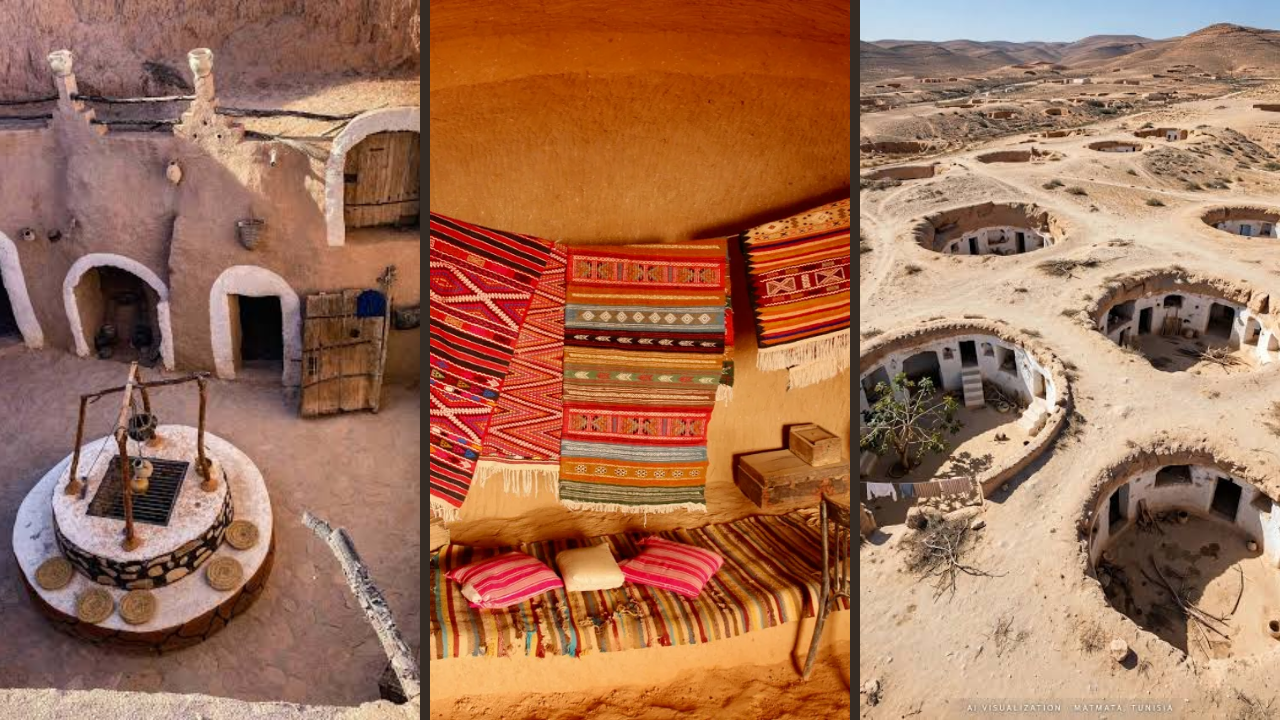
How Matmata Troglodyte Homes Are Built
Reuters, in a 2018 report carried by the Jordan Times, said the homes are rooms cut into the walls of a circular courtyard, with the earth shielding families from summer heat and winter winds. Carthage Magazine described courtyards dug about ten metres into the ground. The Arab Weekly reported that some Matmata troglodyte homes join several pits through connecting passageways. Reuters placed the village about 365 kilometres south of Tunis, while Carthage Magazine put it about 40 kilometres southwest of Gabès.
Why Did People in Matmata Live Underground?
Carthage Magazine reported that historians say the design moderated temperatures and shielded families from the sun, while others believe the homes also served as fortresses during raids by neighbouring tribes. The same outlet said it remains uncertain when local tribes chose to dig rather than build, and Tourism Tunisia said the exact origins have never been definitively documented. Atlas Obscura reported that the area stayed largely unknown to the outside world until the 1960s, when severe flooding brought it to government attention.
According to Carthage Magazine, 22 days of rain in 1969 collapsed many homes and led to the creation of Matmata Nouvelle, an above ground town. Most families rebuilt underground anyway, the magazine reported.
Depopulation and Rebuilding in the Amazigh Village
Reuters reported that many families left the underground houses when new towns were built in the 1960s and 1970s under a modernisation drive led by President Habib Bourguiba. Locals suspect the aim was to dilute Berber communities, Reuters reported, while inheritance disputes, drought and heavy rain also pushed people out. The agency said residents lived mainly from olive farming and tourism.
Reuters quoted Hedi Ali Kayel, 65, one of the last people who knows how to build and maintain the houses. He repairs them after every rain and said
“I do not let them go.”
Star Wars Matmata: Hotel Sidi Driss and Tourism
Reuters reported that Matmata became a popular destination after a troglodyte home converted into a hotel served as a Star Wars set in the 1970s. Carthage Magazine said Hotel Sidi Driss has five linked pits that George Lucas chose in 1976 for the Lars homestead and revisited in 2000 for Attack of the Clones. Tourism across Tunisia was still recovering in 2018 from a decline after the 2011 uprising and the 2015 attacks on tourists in Tunis and Sousse, Reuters reported.
Tourism Tunisia reported that some residents open their homes to visitors, and that places such as Maison Traditionnelle show olive pressing and Berber weaving. Atlas Obscura reported that the traditional structures are threatened as residents move to towns.
Matmata UNESCO Tentative List and Preservation Work
UNESCO’s World Heritage Centre lists “Troglodyte habitat and the world of the ksour of southern Tunisia” as a cultural entry on its tentative list, submitted by Tunisia’s permanent delegation. The entry covers the governorates of Gafsa, Gabès, Médenine and Tataouine and names old Matmata, or Matmata el Guédima, as one component. UNESCO’s text describes a lunar landscape of small hills hollowed at their summits, which are the courtyards of the troglodyte homes. The submission date on the page falls in 2020.
Carthage Magazine reported that Abderrahman Lachheb, president of the Association for the Safeguarding of Old Matmata, said about 1,200 dwellings have been conserved. Some are still inhabited, and others have become hotels and guesthouses.
Conclusion
The Matmata underground houses show how Amazigh families adapted to a harsh climate, and how floods, migration and tourism reshaped the underground homes of Tunisia over decades. Matmata troglodyte homes still draw Star Wars Matmata fans, researchers and families who live below ground. With a UNESCO tentative list entry in place and Hotel Sidi Driss still a landmark, readers searching for Matmata troglodyte homes or Tunisia underground homes will find confirmed details here as the story develops.