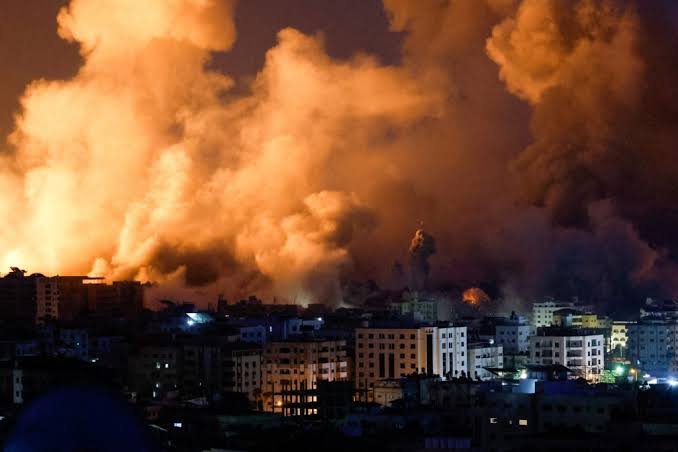
Israeli strikes in Gaza on November 1 killed at least eight people, including a child and five police officers, according to hospital officials, civil defense services, and the Hamas-run Interior Ministry. The attacks occurred in two separate locations despite a ceasefire that has been in place for roughly one year. Gaza health officials and medical sources confirmed the deaths and reported additional injuries, while the Israeli military stated that it had targeted militants or military operatives.
In the northern Gaza City area, specifically the Al-Rimal neighborhood near Cairo School, a missile or drone strike hit a group of civilians. Hospital sources at Shifa Hospital reported three deaths, one of them a four-year-old boy. Video footage from outside the hospital showed mourners gathered near body bags, including the small form of the child wrapped in a white towel. Local residents described the sudden impact in an area where people were sitting in tents or nearby structures. One witness, identified in reports as Ali Oweis, said his son and nephew were killed while sitting in a tent with no apparent military activity nearby. Six other people were wounded in the same incident, according to medical staff.
Further south, in the Al-Mawasi area west of Khan Younis, a drone attack targeted a group of police officers performing routine duties. The Hamas-run Interior Ministry identified the five victims as officers aged between 23 and 53 and described the strike as a “horrific massacre.” Sources at Nasser Hospital confirmed the arrival of the bodies. Local reports noted that the strike occurred near schools, causing panic among children in the vicinity. The Israeli military acknowledged carrying out strikes in the Khan Younis area against what it called militants or a terrorist but did not immediately release detailed evidence or further information on the Gaza City incident.
These events form part of a pattern of continued Israeli air operations in Gaza since the ceasefire took effect in October 2025. Palestinian health authorities state that more than 1,500 people have been killed in Israeli attacks during the ceasefire period, a figure the United Nations has previously treated as credible in similar contexts. Israel has maintained that Hamas has been rearming and launching attacks in violation of the agreement, while Hamas has denied rebuilding its arsenal and accused Israel of systematically undermining the truce. Nearly all of Gaza’s more than two million residents continue to live in damaged buildings or makeshift shelters, with large portions of civilian infrastructure destroyed during the earlier phase of the conflict that began after the October 7, 2023 Hamas attacks.Hospital scenes reflected the immediate human cost. At Shifa Hospital in Gaza City, crowds gathered for prayers beside the bodies. At Nasser Hospital in Khan Younis, women were seen grieving over body bags laid on the floor. Civil defense teams recovered the remains and transported the wounded. An additional death was reported from wounds sustained in a previous attack, bringing the day’s confirmed toll to at least eight according to multiple medical sources.
The ceasefire has never fully halted hostilities. Israeli strikes have occurred on an almost daily basis according to local reporting, while both sides exchange accusations of violations. Gaza’s Interior Ministry and Hamas officials framed the latest deaths as deliberate targeting of civilians and security personnel. Israeli statements focused on the elimination of military threats. Independent verification of the precise identities and roles of those killed remains limited in the immediate aftermath, as is common in ongoing conflict reporting from the territory.
Broader context includes the heavy cumulative toll since October 2023. Palestinian health ministry figures, widely cited by international organizations, put total deaths above 74,000. The current round of strikes adds to the strain on an already overwhelmed medical system operating with limited resources, damaged facilities, and restricted movement. Aid access and reconstruction have proceeded slowly under the fragile truce conditions.
International coverage from outlets including BBC, Reuters, Al Jazeera, and others highlighted the civilian casualties, the presence of a young child among the dead, and the targeting of police officers on duty. Photographs and video distributed by news agencies showed funerals, ambulances, blood stains on streets, and emotional reactions from families. These images underscored the continued impact of the conflict on daily life in Gaza even during periods formally described as ceasefires.
The events of November 1 illustrate the persistent gap between the formal existence of a ceasefire and the reality of ongoing military activity. Both Israeli and Palestinian authorities continue to present conflicting narratives about who is responsible for violations and what constitutes legitimate targets. For residents of Gaza City and Khan Younis, the practical result has been further loss of life, additional wounded, and renewed fear in neighborhoods already marked by earlier destruction.
Medical sources emphasized the difficulty of treating casualties under current conditions. Hospitals receive patients with trauma injuries while also managing the broader public-health challenges that have accumulated over years of conflict. The presence of children and civilian police among the dead has intensified local condemnation and calls for stronger international pressure to enforce the truce terms.
As of the latest available reports, the Israeli military indicated it was examining the results of its operations. No comprehensive independent investigation into the specific incidents had been completed in the immediate hours after the strikes. Palestinian officials continued to list the names of the police officers killed and to demand accountability. The cycle of strike, casualty reports, competing statements, and limited verification remains the dominant pattern in coverage of the Gaza situation more than a year after the formal ceasefire began.
The November 1 attacks therefore stand as another episode in a longer sequence of violence that has not fully ceased despite diplomatic agreements. They add to the documented Palestinian death toll under the ceasefire and reinforce the challenges facing any effort to stabilize conditions for the civilian population. Hospitals, civil defense teams, and families continue to manage the consequences on the ground while political and military statements from both sides frame the events according to their respective positions.